Showing posts with label environment. Show all posts

Monday, June 22, 2026

Two Days (in One)

World Rainforest Day 


Rainforest Leaf: photo by Cliff Hutson


Some say that “luck” is when preparation meets opportunity. So, luck or not I always appreciate it when a Monday rolls around, it is a notable day, and I have a photo in my archive to go with it. It makes that week’s blog post easy-peasy. This week I am going with a twofer. 

June 22 is World Rainforest Day. A rainforest is not my favorite environment - too humid, too buggy. But, I do recognize their importance; they support more than half of all known plant and animal species and play a crucial role in regulating the world’s climate; and was once in a place where I took a photograph that is a personal favorite. It just captures that day for me.


National Chocolate Eclair Day


Eclair: photo by Cliff Hutson


On the other hand, I love eclairs, and thought that I would have several images from which to choose. But, when I ran my search of the archives the one photo that came up as not the one I had in mind. I guess it is on a drive to which I no longer have access to or otherwise has become lost in the mists of time. This one will do nicely though.

National Chocolate Eclair Day is also observed on June 22 every year in the United States to celebrate this delicious dessert.


Monday, August 8, 2022

Reading Log: July 2022

The books I finished reading in July 2022
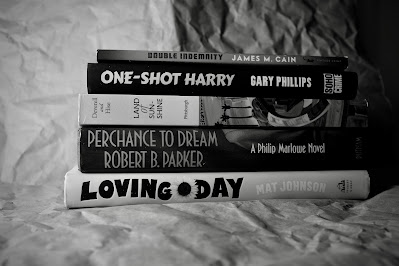

July 2022 Books: photo by Cliff Hutson


"Loving Day," Mat Johnson

"Perchance to Dream," Robert B. Parker

"Land of Sunshine: An Environmental History of Los Angeles," William Deverell and Greg Hise 

"Double Indemnity," James M. Cain

"One-Shot Harry," Gary Phillips


Cliff's Notes


Double Indemnity: photo by Cliff Hutson


"Loving Day"


We have, through out our lives received countless messages about which categories we belong to, or don’t. This informs how we tend to view the entire social world and our place in it. This book asks the question — "Why are you calling yourself black and not biracial? " 

The novel's title obviously refers to Loving Day, when the U.S. Supreme Court nullified bans on interracial marriage. Baz Dreisinger has described it as "a semi-autobiographical" "extended literary metaphor about race and mixed-race in America." 

Certainly, if any of my friends were to read it they would have a greater insight into my life, which can be viewed as partly truth and partly fiction.

"Perchance to Dream"


This title is a literary reference — to Hamlet's famous soliloquy which begins "To be or not to be",  But, rather than a contemplation of suicide, it is a clever sequel to "The Big Sleep" by Raymond Chandler. 

It is my opinion that Parker does a much better job of emulating Chandler in this volume than he did in "Poodle Springs." I very much enjoyed it.

"Land of Sunshine"


The title of this book also harkens back to a prior publication. As the full title implies, the book is an exhaustive look at the environmental history of greater Los Angeles from ancient times to the very recent past. Which is to say that it provides a framework to examine where the city started and how it got to where it is today.

It drags a bit in parts, but rather than just reading what I thought would be the sections that held the most interest for me going in, I read the entire book.

"Double Indemnity"


First published in 1935, or 1943 depending on your source, this novel is probably the exemplar of noir fiction. One review says that it is  — "Tautly narrated and excruciatingly suspenseful, Double Indemnity gives us an X-ray view of guilt, of duplicity, and of the kind of obsessive, loveless love that devastates everything it touches." I can't put it better than that, so I won't try.

The 1944 film of the same name, whose adaption was co-written by Raymond Chandler and Billy Wilder,  is one of my all time favorites.  The book and the film are both excellent in their own right. I can't recommend them highly enough.

"One-Shot Harry"


Gary Phillips has been a writer for thirty years, but this book is my first exposure to him. I like on several levels. First of all it is about a photographer and is well written, the suspense keeps drawing the reader along. Secondly, it is set in Los Angeles. during the time I was there in my teens. I know well many of the places to which the plot takes us. Phillips also captures the essence of the ubiquitous racism that permeated the LAPD under the leadership of chief William H. Parker. So, not only is it a good crime story, it provides a bit of history that many people are unaware of or have chosen to ignore.


Monday, July 18, 2022

World Listening Day

“Listening Across Boundaries”


Today, July 18, is World Listening Day. It is hosted every year by the World Listening Project, a nonprofit organization that is “devoted to understanding the world and its natural environment, societies, and cultures through the practice of listening and field recording.” 

The theme for 2022  is “Listening Across Boundaries”.  The purpose is to explore the role of listening across various branches of knowledge; how natural soundscapes do not recognize human-drawn boundaries; and seeming limitations or barriers to listening that can be overcome.

July 18 was chosen because it is the birthday of the composer R. Murray Schafer, one of the founders of the Acoustic Ecology movement.


Acoustic Ecology 


Radio Expeditions: photo by Cliff Hutson


This article in Physics Today is a good introduction to acoustic ecology, “a field that examines how animals, including humans, use information obtained from the environment [mediated through sound] in different aspects of their lives.”


Soundscapes


Headphones: photo by Cliff Hutson


A common definition of soundscape is the it is a mélange of musical and sometimes nonmusical sounds. However, wherever you are, you are surrounded by a soundscape. Very similar to how a landscape depicts a view of the land in front of you, a soundscape captures the audio of all the sounds around you. 

Soundscape ecology, of course, affects not only humans but also the other beings that live amongst us. A notable aspect of the shutdowns due to the COVID pandemic was that birds changed their tunes. 


Soundwalk


Soundwalk: photo by Cliff Hutson


One way that most of us might be able to observe World Listening day is to take a soundwalk - a walk with a focus on listening to the environment, no matter where we are.