Showing posts with label Baja. Show all posts

Wednesday, April 18, 2018

Shaw's Agave

One of my favorite books from my younger days has a poem with the line, “All that is gold does not glitter”. I would turn that around for Coastal, or Shaw’s, Agave and say, all that is drab is not as dull as it seems. Sometimes one just has to wander around until they see things in the proper light.

Coastal agave, i.e., Agave shawii is a succulent with closely spaced, overlapping sword-shaped leaves that measure up to 8 inches wide and about 18 inches long. They diverge from the center of the plant in a spiral making for a rounded shape. The deep green leaves are edged with spines.

These spines nominally appear as brown or gray and don't offer much in the way of a visual display. However, in early morning or late afternoon, when the the sunlight comes in from behind the plant, they light up and glow red and/or orange, rivaling any neon sign on the Las Vegas Strip. 

Coastal Agave
Shaw's Agave by Cliff Hutson

The leaves are also notable for bearing the imprint of the spines of the leaves that were in front and back of them when they were clasped together. I find this to be a charming visual element to the plant.

The flowering plant is also attractive. It may take 20 to 40 years before it flowers. But, then yellow blooms, looking much like  a hand of very small bananas, burst out on the top of an 8 to 12 foot stalk resembling an asparagus spear. The flowers attract hummingbirds, bats and bees. When a single plant flowers it dies, but its “pups” or clones will live on.

Bats are a key pollinator of this agave and probably the primary reason for the tallness of the flowering stalk. Bats, save for the few species of vampire bats, can not launch into flight by flapping their wings. they, instead, take off by dropping from a height be it the roof of a cave, bridge, or tall plant with sturdy flowers.


Coastal Agave is found in Baja California. Also native to California, it occurs naturally only in San Diego County, near Border Field State Park. Most of the plants that were there were bulldozed into oblivion by your government while building the boundary wall between the USA and Mexico. However, a few seem to have survived. Other populations exist elsewhere in Southern California, but they were probably planted out in an effort to preserve the plant. I, for one, certainly hope it stays with us.

Wednesday, August 17, 2016

Holly in California?

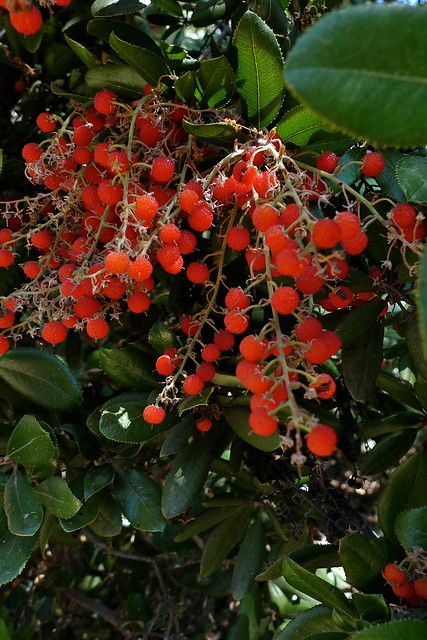
Comarostaphylis diversifolia
Summer Holly: photo by Cliff Hutson

Plants of the genus Ilex (Holly) are not native to California, though some may have naturalized. However, several of our native plants do have "holly" as part of their common names. This is no doubt due to their having pointy leaves and red berries, but in total disregard to their taxonomy. 

Summer holly (Comarostaphylis diversifolia) is found in coastal chaparral from Santa Barbara County southerly into Baja California. There may be populations on the Channel Islands as well. Some sources cite that the geography makes for two subspecies: Comarostaphylis diversifolia ssp. diversifolia in coastal Southern California and Baja; and Comarostaphylis diversifolia ssp. planifolia on the Channel Islands and the Transverse Ranges north of Los Angeles. It is not very common, but not yet listed as rare.

A slow‐growing, evergreen shrub or tree to 20 ft. tall. Attractive features include shiny leaves, white flowers, red berries and shredded bark. While the flowers are urn-shaped similar to the more familiar manzanita, the red berries are warty or wrinkly rather than smooth. That feature also distinguishes it from toyon. Summer holly is a member of Ericaceae, commonly known as the heath or heather family, a family of flowering plants found most commonly in acid and infertile growing conditions.

Summer Holly can be used in the home landscape. It does well in dry part shade and does not tolerate direct water in the summer. Some care must be taken, but one pay off is that birds are attracted to the fruit.
SaveSaveSaveSave

Wednesday, February 10, 2016

Boojum Tree


"'But oh, beamish nephew, beware of the day,
If your Snark be a Boojum! For then
You will softly and suddenly vanish away,
 And never be met with again!”

“The Hunting of the Snark” by Lewis Carrol

Boojum Tree: photo by Cliff Hutson

Unlike Jack London, I have never had a Snark to call my own. Many years ago I considered buying one, but my wife pointed out that there was not enough room in my life for both a spouse and a sailboat, even a small one.  However, I have gazed upon the visage of a Boojum, many times and not vanished.

Fouquieria columnaris, or Boojum, is a tree in the same family as Ocotillo; Fouquieriaceae (Candlewood). The boojum is basically endemic to the Baja California Peninsula, but can be considered as being in the California Floristic Province. Many say it resembles a slender upside-down carrot, up to 50 feet tall and about 1-1/2 feet wide at the base. It is covered with spiny twigs that bear whitish to yellowish flowers in hanging clusters during the Summer; and sometimes in the Fall.  As with ocotillo, its small leaves drop off in drier conditions, leaving the greenish stems to carry out photosynthesis.

Fouquieria is named for Pierre Éloi Fouquier (1776-1850), a French physician,  professor of medicine and naturalist. The epithet, columnaris means  “in the shape of a column”, referring to the stout upward tapering trunk. The common name of Boojum Tree was given by Godfrey Sykes of the Desert Botanical Laboratory in Tucson, Arizona. He apparently named it after the mythical being citied the nonsense poem written by Lewis Carroll, the pen name of Charles Lutwidge Dodgson.


Fouquieria columnaris: photo by Cliff Hutson