Showing posts with label Holly. Show all posts

Monday, February 28, 2022

Two Treats and a Flask of Bourbon

The Call of the Mountains


The Call of the Mountains: photo by Cliff Hutson


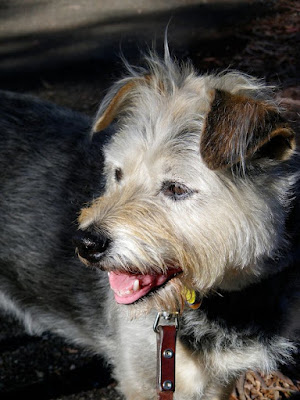
I used to write a blog titled "Rambles with Holly". It, among other things, was about the walking and hiking that I did with my dog, Holly.  My original plan was to call it "Travels with Holly" as an homage to Steinbeck, but that name was already taken at the time. As it turns out, we did a lot more walking locally than traveling, so it was probably for the best. The blog went on hiatus in 2014 after Holly crossed over the Rainbow Bridge.

However, a cartoon I came across the other day brought back memories of the good times that she and I had together. 


Holly and Me: photo by Cliff Hutson


I am taking the liberty of publishing it here.

Two Treats and a Flask of Bourbon


Bliss Cartoon
Bliss Cartoon


The bourbon was mine


Classic Stanley Flask: photo by Cliff Hutson


Plenty of water and treats, for both of us, were a regular thing. I seldom packed this flask, but I kept it handy in case the occasion should ever arise. 


Aged Bourbon: photo by Cliff Hutson

I like to think that I kept my bar adequately stocked as well.


On the Trail


A Happy Dog: photo by Cliff Hutson

Fair weather or foul, Holly was in her element when she was on the trail. A life outdoors is a life well lived.


Monday, November 30, 2020

Dodder

California Dodder

One of the sites I referred to when preparing to write about a plant I encountered in my rambles is maintained by the Consortium of California Herbaria  which provides information about California vascular plant specimens that are housed in participant herbaria. One can search on just about any plant and obtain a list of accessions from around the state.

California Dodder (Cuscuta californica), hits close to home as it has records dating from 1897 to 2009 for specimens found in and around Claremont. One was collected from the Bernard Field Station. The other was found along Thompson Creek, where Holly and I often passed by the plant on our walks.

California Dodder: photo by Cliff Hutson

Cuscuta californica, also called Chaparral Dodder, is an annual parasitic herb or vine that is native to California. It is also found outside of California, but is confined to western North America. Dodder is readily identified by its threadlike, hairless, yellow, orange, or red shoots which twine around host plants eventually creating a tangled mat. One notable feature is that it does not usually have roots that reach the ground. Instead, knoblike organs along the shoot (haustoria) penetrate the host stem. Shoots either lack leaves or have very tiny red, yellow, or orange scalelike leaves pressed close to the stem. It tends to bloom from May through October. The white flowers are tiny, only about 3 to 6 millimeters wide. The fruits are even smaller.

Dodder once had its own family, but it is now consigned to CONVOLVULACEAE, the Morning Glory Family. The epithet Cuscuta seemingly comes from Cuscu'ta a name of Arabic derivation meaning "dodder”. The common name, Chaparral Dodder, tips us to one of its habitats. It is also found through out the state in many other plant communities such as forests and grasslands. And, of course, “the City of Trees and PhDs”.

Wednesday, August 17, 2016

Holly in California?

Comarostaphylis diversifolia
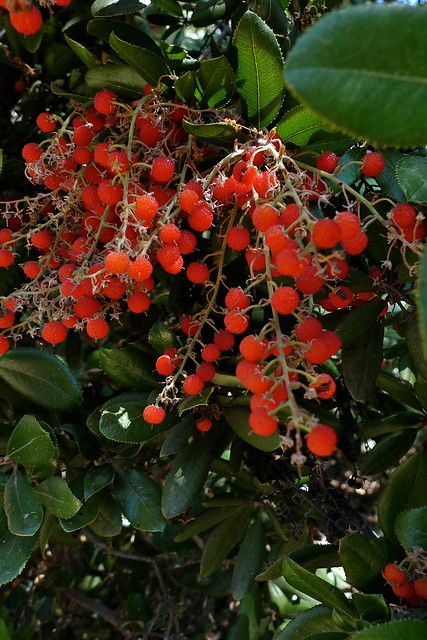
Summer Holly: photo by Cliff Hutson

Plants of the genus Ilex (Holly) are not native to California, though some may have naturalized. However, several of our native plants do have "holly" as part of their common names. This is no doubt due to their having pointy leaves and red berries, but in total disregard to their taxonomy. 

Summer holly (Comarostaphylis diversifolia) is found in coastal chaparral from Santa Barbara County southerly into Baja California. There may be populations on the Channel Islands as well. Some sources cite that the geography makes for two subspecies: Comarostaphylis diversifolia ssp. diversifolia in coastal Southern California and Baja; and Comarostaphylis diversifolia ssp. planifolia on the Channel Islands and the Transverse Ranges north of Los Angeles. It is not very common, but not yet listed as rare.

A slow‐growing, evergreen shrub or tree to 20 ft. tall. Attractive features include shiny leaves, white flowers, red berries and shredded bark. While the flowers are urn-shaped similar to the more familiar manzanita, the red berries are warty or wrinkly rather than smooth. That feature also distinguishes it from toyon. Summer holly is a member of Ericaceae, commonly known as the heath or heather family, a family of flowering plants found most commonly in acid and infertile growing conditions.

Summer Holly can be used in the home landscape. It does well in dry part shade and does not tolerate direct water in the summer. Some care must be taken, but one pay off is that birds are attracted to the fruit.
SaveSaveSaveSave

Wednesday, July 13, 2016

To See, or Not to See

Deer on Creek: photo by Cliff Hutson

An Artificial Obvious


One of the most asked questions along the Thompson Creek Trail is - “did you see the the deer?” To which, alas, I usually have to answer “no”.

I have seen quite a few deer in my lifetime. When I was in high school I spent a lot of time running through the hills and dales of Griffith Park in the City of Los Angeles and saw them all the time, usually on the golf courses. It is kind of difficult to miss a good sized herd of large animals on a closely trimmed fairway. And, I did manage to see this one along the creek in the above photograph.

Seeing them in the mountains is another story. This was painfully brought to my attention about forty years ago when a young woman of my acquaintance invited me to spend a weekend at her family’s cabin in Mineral King. One evening the two of us and another couple sat on the east-facing porch to watch the setting sun illuminate the west-facing slope across from us. The other three began seeing what must have amounted to dozens of deer. I never saw a one, much to my embarrassment.

Stewart Edward White tells in The Mountains that deer can be invisible to the untrained eye even when they are standing in plain sight. Seemingly, many people, like me, can look straight at them and not see them at all. White discusses what he calls creating “an artificial obvious” as the key to seeing deer.

I first came upon the phrase while reading Annie Dillard’s A Pilgrim at Tinker’s Creek. She did not shed much light on it as far as was concerned. But, now that i have gone to the source, I now understand that in a way we all view the natural world through a filter of sorts. This is to say that in any given situation we tend to see what we want to see and disregard the rest. Thus as I walk along the creek I first pay attention to the light as a photographer. Secondly I tend to notice plants, flowers, and birds based on my work at the botanic garden. Therefore, my eye tends to skip over the brown or gray splotches that would be deer. White, on the other hand, as a hunter will pass his eye over a slope and miss the flowering bush but see the buck which was hidden to me.

Mule Deer: photo by Cliff Hutson

Holly, the dog I hiked with for many years, constructed her own artificial obvious as well. Hers appeared to be based on size. A lizard of say two to three inches was of no importance. A larger one was worthy of investigation. Her interest ranged through birds such as towhees, squirrels, rabbits, cats, and other dogs. She could spot a cottontail the same distance from us as the deer in the above photo and become excited. Yet, she would exhibit no indication that a deer was there at all. Perhaps she felt that at her size large mammals were best ignored. If you pretended they were not there, they might not see you and just go away. Small reptiles and insects must have been beneath her dignity. It occurs to that the little random bred's make-up is primarily terrier. Terriers were bred to pursue vermin such as rats and foxes. These certainly fall within the size of animals that attracted her attention. So, Holly's artificial obvious could have been genetic.

Do we all live in a world of our own making?
SaveSaveSaveSaveSaveSaveSaveSave

Wednesday, April 24, 2013

Cats and Health


I read in Spry Magazine that owning a cat has a real benefit to my health. Cat owners are 40% less likely to of a heart attack and 30% less likely to die of stroke, heart failure, or cardiovascular disease.

The blurb said that one reason maybe that interacting with cats reduces anxiety and stress. However, I find that cat ownership certainly has its own set of demands. As the joke goes - "Cats, e.g. Pumpkin (pictured) and Mini, are alarm clocks that need to be fed."

Having a dog like my Holly, of course, encourages many people to get more exercise through taking walks, playing fetch, and the like. However, Spry maintains that pets, even fish, are associated with better health in their owners.

Friday, June 4, 2010

Walking the Dog


Walking the Dog
Originally uploaded by The Marmot
Even the most casual of observers can see that I do not update this blog on a regular basis. So, working on the theory that not posting to two blogs is as easy as not posting to one I have started "Rambles With Holly" at http://rambleswithholly.blogspot.com/

The “ramble” is a classic form of nature writing marked by a “perfect balance” between the natural history and the presence of the author. John Burroughs and Annie Dillard as being good examples of this craft.

Please check it out if you have some time.