Showing posts with label nature. Show all posts

Monday, April 20, 2026

En transition

 Les feuilles vertes deviennent brunes


En transition: photo by Cliff Hutson


"Et les feuilles vertes deviennent brunes,
Et elles se flétrissent au gré du vent,
Et elles s'effritent entre tes mains."


Monday, March 30, 2026

Take a Walk in the Park Day

 Celebrate National Take a Walk in the Park Day


Take a Walk: photo by Cliff Hutson


"Take a Walk in the Park Day" is observed every year on March 30. So, today may be special. However, any day is a good day to take a walk in a park, Research suggests that walking in natural settings offers added benefits compared with more built‑up environments.


Monday, July 8, 2024

Photo a Day

 AKA: Photography 365 Challenge


Another Monday, another cop out.  One might think that a retired person who has made a commitment to post to their blog every Monday should be able to easily follow through on that with something at least a bit substantial. But, once again, I got distracted and am resorting  to a fluff piece.

I am in the middle of an ongoing Photo a Day (PaD) project. The photo at the top is the one that I am using for today's effort. What follows is a random sampling from this year.


The project has become a mix of food photography, street photography, nature photography, and what may as well be called snapshots.  Some days the result is much better than others. If your curiosity has been piqued, the oeuvre is available in my PBase.com gallery. 


All writing and images ©Cliff Hutson unless expressly noted. Do not use without permission.


Monday, June 24, 2024

Landscapes

Ain't too proud


I am riffing on last week's use of a "borrowed" theme. So, here are a few random landscapes. They are fun to photograph.


All writing and images ©Cliff Hutson unless expressly noted. Do not use without permission. 


Monday, May 20, 2024

World Bee Day

World Bee Day 2024: We all depend on bees


World Bee Day (May 20 of each year) was designated by the United Nations to raise awareness of the importance of pollinators, the threats they face and their contribution to sustainable development.


It has long been noted that bees play a vital role in the environment by pollinating plants, supporting agriculture, promoting biodiversity, and also ensuring the survival of many plant species.  Our lives would be much poorer without them.


We should all be mindful of them for their sake and ours.


All writing and images ©Cliff Hutson unless expressly noted. Do not use without permission.


Monday, April 22, 2024

Earth Day


 April 22 is Earth Day


Mountain Majesty: photo by Cliff Hutson


We should honor the earth everyday, but today marks an annual event founded by people who hoped to stir activism to clean up and preserve our planet. This year's theme, "Planet vs. Plastics", further aims to raise awareness of the harms of plastic pollution for human and planetary health.


Words to Live By


Earth Day 2014: photo by Cliff Hutson


I make the attempt anyway. One goal of life is to live in harmony with nature.


Monday, January 8, 2024

Reading Log: December 2023

The books that I finished reading in the month of December 2023: 


December 2023 Books: photo by Cliff Hutson


Cliff's Notes


"True West"

I was very disappointed in this book, thinking that it would contain more history than personal stories. The author maintains, based on her personal experiences, that America can be brought together if we meet our fellow Americans where they are.

That may be easy for a well to do, somewhat noted, white woman to say. It is not so practical in a land where a service station in Arizona refused to sell me gas, or where my wife were seated in a restaurant in Idaho Falls but never served. 

She does write well though.

"Pests"

"Pests are what happens when we think that we've got nature all figured out, and nature decides to give us the finger."

This was both an entertaining and informative read.

"Hondo"

My newspaper of record recently devoted several paragraphs to a discussion of the movie of the same title and the novel as they both mention a local community - San Dimas. I decided to watch the movie and then read the book, which was based on the movie rather than the usual sequence. They were both pretty darn good. Each in its own way.

See how they differed was illuminating. A novelist can use extensive character description and metaphors.  A screenplay has to solve the problem of how to put necessary information in to the mouths of characters whereas a novel can just tell the reader about it.  

So, at bottom, I will say that I enjoyed the book more. Mostly because it gave me some leeway to enjoy the landscape as it were, rather than have it relegated to the background as I keep an eye on the actors. But, let me go on record as saying that I will never give up one form for the other.

"Out There"

Another enjoyable read. But, then I seem to have an inborn fascination with the juxtaposition between science fiction and real science. I came of age during a time when many of the things first hinted at in books and movies became (more or less) actual technological advances. This book limns the way real life and science fiction may intersect. 


Monday, January 1, 2024

Bonne année!


Happy New Year!


Dogwood: photo by Cliff Hutson


Wishing you a happy New Year, filled with peace, love and joy!

I am resolving to get up early and go outside.


Monday, December 25, 2023

My Best Shot of 2023

 Not too shabby:


Tuesday Afternoon: photo by Cliff Hutson


Some say that December is a good time to reflect back on what happened before the year slips away. However, I feel that the beginning of the month is too early to start publishing "best of" lists. Who knows what may still lie ahead? Still, when I saw that Flickr was asking for "Your Best Shot 2023" I went ahead and submitted the above photo. It was taken in June, but odds are I will not do much better before the end of this year.

I like it for a couple of reasons. One is that I planted the seed(s) from which the plant grew. The other is that I took photos over the course of several days, and times of day, until I made the image I wanted. Thus, the title "Tuesday Afternoon." 

Looking forward to 2024, I am thinking of doing more work with my iPhone SE, or may be taking up another Photo a Day project. There will be photos in any event. See you in the new year.


Monday, November 6, 2023

Reading Log: October 2023

The books that I read in the month of October 2023 


October 2023 Books: photo by Cliff Hutson


"Judgement Prey," John Sandford


"The Ninth Inning," A.J. Stewart

"Big Thaw," A.J. Stewart

"Devil's Backbone," A.J. Stewart


Cliff's Notes


"Judgement"

This is another book in John Sanford's "Prey" series. Lucas Davenport and Virgil Flowers team up to solve the cold blooded murder of a judge and his two sons. 

"Naming"

As a volunteer "nature interpreter" at a botanic garden I experienced first hand the disconnect between the way visitors viewed the world and that of the professional staff. The author does a good job of discussing this and trying to reach some common ground.  

"War and Peace

What did Abraham Lincoln mean by A house divided against itself cannot stand"?

Lincoln paraphrased the following passage from the Bible, Matthew 12:25, when he spoke of a house divided:

And Jesus knew their [the Pharisees'] thoughts, and said unto them, "Every kingdom divided against itself is brought to desolation; and every city or house divided against itself shall not stand."

Lincoln’s ‘House Divided’ speech teaches important lessons about today’s political polarization,  the main point made by this book.

Miami Jones mysteries 

Miami Jones is my favorite Florida based private detective. These stories are not only really good crime fiction they also can impart some interesting information such as what goes into making ice for a hockey rink or the running of a fishing tournament. 


Monday, April 17, 2023

California Native Plant Week - 2023

Celebrating Eight Days a Week


California Poppy: photo by Cliff Hutson


This year, California Native Plant Week runs from April 15 thorough April 22 (Earth Day).  The state is one of the most biodiverse regions on the planet with more than 6,000 types of plants. I thought that I would share some photos of some of my favorites (in no particular order). 


Five Spot: photo by Cliff Hutson


California Bay: photo by Cliff Hutson


Datura: photo by Cliff Hutson


Tidy Tips: photo by Cliff Hutson


Flannel Bush: photo by Cliff Hutson


Matilija Poppy: photo by Cliff Hutson


Shaw's Agave: photo by Cliff Hutson


Sticky Monkey Flower: photo by Cliff Hutson


Monday, March 27, 2023

Reading Log: February 2023

The books that I finished reading in the month of February 2023


February 2023 Books: photo by Cliff Hutson


"Gaia," James Lovelock

"The Big Ones: How Natural Disasters Have Shaped Us," Dr. Lucy Jones

"The Afrominimalist's Guide to Living with Less,' Christine Platt

"The Forgotten Man." Robert Crais


Cliff's Notes:


"Gaia"

This book proposes that the earth is a living, self regulating organism. I firmly believe that this is a worthy hypothesis that bears investigation. I also feel that that Lovelock, the progenitor of the theory, seems to be one of the most ill-equipped scientists to argue in its favor. 

My concern arises from his beliefs that pollution is not a a major concern, Big Oil would not lie to us about the effects of burning fossil fuels, and that non-industrial countries present a bigger threat to the environment than Europe or America. 

All in all, I do not recommend this book.


"The Big Ones"    

A very cool book about natural disasters, of all stripes, and how they have shaped history and (perhaps) the human psyche. 

By waiting so long to write this review I have the benefit of seeing how the current flooding in California is evocative of what occurred in 1861-62; a history of which most Californians are unaware. 

One lesson more of us should take to heart: "Love, thank, and cherish your loved ones every day of your ... ."


"Living with Less"


One of the things that I have trying to accomplish, with little success, over the past few years is paring down my possessions so that I can move to a much smaller home. Having stalled out in this endeavor I was hoping that this book might give me a jump start. It was not much of a help. But, that may just be me.

The author puts a lot of emphasis on discovering one's authentic self. It seems that my authentic self is someone who is mildly depressed and sits around the house wearing sweatpants.


"Forgotten"


Another fun read in the bestselling series of Elvis Cole and Joe Pike stories. 


Monday, June 13, 2022

Nature Notes: Datura

 Toloache

A plant of many names.
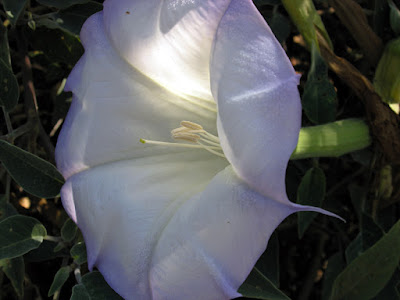

Toloache: photo by Cliff Hutson

Datura wrightii


Datura, the name I first learned, is a member of the Nightshade family (Solanaceae) and is not uncommon from Central California to northern Mexico and east across the Southwest to Texas. It is, in fact fairly common in the foothills north of my home. So you may imagine my surprise that two of my field guides: "Introduction to California Chaparral" and "Introduction to the Plant Life of Southern California: Coast to Foothills" fail to mention it.

Perhaps this is due to the plant’s seedy reputation. Easily recognized by its trumpet-shaped flowers , it has been used for hundreds of years for its hallucinogenic properties. However, it is as toxic as it is narcotic and has been responsible for the deaths of some seeking to use it for its traditional religious purposes; or more likely, recreation.

Like many Americans of my generation, I first learned of the properties of Datura, also called Jimsonweed, through reading Carlos Castaneda’s "The Teachings of Don Juan". His purported experiences led many to go out and try it for themselves. Surprisingly, I never did.

I say surprisingly as I have gone through what I called a Euell Gibbons phase and have an abiding interest in ethnobotany, as evidenced by my work at Rancho Santa Ana Botanic Garden. These pursuits have led me to consume more than a few native plants of California. But, I have a healthy respect for for things that might kill me if I do not know what I am doing and figure to give Datura a permanent pass.

The book "California Indians and Their Environment: An Introduction" by Kent G. Lightfoot and Otis Parish has a few interesting entries on what they call Toloache. They describe religious uses, such as gaining the ability to transcend reality, and medicinal purposes. Some groups prepared it in a drink as a painkiller and a treatment for a variety of ailments.

Speaking of names, the "National Audubon Society Field Guide to North American Wildflowers" refers to the plant as Southwestern Thorn Apple. It says that the common name Jimsonweed is a corruption of Jamestown Weed. The story goes that it got the name when many soldiers sent to quell Bacon’s rebellion in 1676 were poisoned by it.

Jimsonweed


Jimsonweed: photo by Cliff Hutson

By the way, the flower is typically white (see above), but  may be some times tinged with violet, as shown in the lead photograph.


Monday, May 16, 2022

Love a Tree Day

 National Love a Tree Day


Trees: photo by Cliff Hutson


National Love A Tree Day comes on May 16th, right in the middle of Garden for Wildlife Month, That makes sense as trees not only provide food and shelter for birds and other animals. 


As a matter of fact, trees are some of the most important plants on the planet and humanity’s very existence depends on their continued well-being. They provide us with lumber, nuts, fruit, shade, and shelter. In addition, they produce oxygen for us to breathe and help to absorb excess carbon dioxide from the atmosphere. So, we should give them the attention that they deserve, today and everyday.

Giant Sequoias: photo by Cliff Hutson

By the way, trees are not a taxonomic group but include a variety of plant species that have independently evolved a trunk and branches seemingly as a way to stand above other plants to compete for sunlight. 


Monday, April 25, 2022

Oak Woodland

 Oak Woodland


Oak Trees: photo by Cliff Hutson


When I picture an oak woodland in my mind it is one with coast live oaks that stand closely together so that their canopies overlap. Low bushes cover the ground along with a layer of debris.

Coast live oak (Quercus agrifolia) is the most abundant species of oak along the California coast, ranging from Sonoma County into Baja California. Of course, in other parts of the state different oaks will predominate; but coast live oak is the one I grew up  and continue to see almost daily.

It is well adapted to to our Mediterranean climate of hot, dry summers and cool, hopefully rainy winters. Coast live oaks are evergreen, with a tough little leaf. 


Leaf and Acorn (Quercus agrifolia): photo by Cliff Huston


The oak woodland is one of my favorite habitats. More than coincidently, I guess, in it are found some of my favorite animals as well: Acorn Woodpecker, Western Scrub Jay, and Western Gray Squirrel to recite just three. Plants in this habit could include California Bay and Toyon.


California Bay: photo by Cliff Hutson


I have read that many early settlers wrote about the mystical beauty of oak trees. I certainly get an inspirational feeling when ever I get the opportunity to spend some quiet moments of reflection in a such a grove.


Coast Live Oak: photo by Cliff Hutson


Monday, December 13, 2021

Nature Notes: Boojum

Boojum Tree 


"'But oh, beamish nephew, beware of the day,
If your Snark be a Boojum! For then
You will softly and suddenly vanish away,
 And never be met with again!”

“The Hunting of the Snark” by Lewis Carrol


Boojum Tree: photo by Cliff Hutson

Unlike Jack London, I have never had a Snark to call my own. Many years ago I considered buying one, but my wife pointed out that there was not enough room in my life for both a spouse and a sailboat, even a small one.  However, I have gazed upon the visage of a Boojum, many times and not vanished.

Fouquieria columnaris, or Boojum, is a tree in the same family as Ocotillo; Fouquieriaceae (Candlewood). The boojum is basically endemic to the Baja California Peninsula and parts of the Sonoran Desert, but can be considered as being in the California Floristic Province. Many say it resembles a slender upside-down carrot, up to 50 feet tall and about 1-1/2 feet wide at the base. It is covered with spiny twigs that bear whitish to yellowish flowers in hanging clusters during the Summer; and sometimes in the Fall.  As with ocotillo, its small leaves drop off in drier conditions, leaving the greenish stems to carry out photosynthesis.

Fouquieria is named for Pierre Éloi Fouquier (1776-1850), a French physician,  professor of medicine and naturalist. The epithet, columnaris means  “in the shape of a column”, referring to the stout upward tapering trunk. The common name of Boojum Tree was given by Godfrey Sykes of the Desert Botanical Laboratory in Tucson, Arizona. He apparently named it after the mythical being citied the nonsense poem written by Lewis Carroll, the pen name of Charles Lutwidge Dodgson.


Fouquieria columnaris: photo by Cliff Hutson
Fouquieria columnaris: photo by Cliff Hutson


Sadly, the extremely limited range of habitation of this impressive tree renders its continued survival a matter of great concern among many experts in spite of its being a protected species. They can found closer to home, for some of us. One place to visit a large collection is at the San Diego Zoo's Wild Animal Park. Other specimens are at the Desert Botanical Garden in Phoenix, the Huntington Botanical Gardens in San Marino, California, and the California Botanic Garden in Claremont, California.

Monday, November 29, 2021

Nature Notes: Coast Live Oak

 Coast Live Oak


Coast Live Oak: photo by Cliff Hutson


The coast live oak (Quercus agrifolia) derives its name for the reason that, as an evergreen, it does not shed its leaves for a dormant season. It is is native to California, occurring in our Mediterranean habitats which are characterized by mild, wet winters and hot, dry summers. and is the most abundant species of oak along the coast, ranging from Sonoma County into Baja California. 

It is notable that the coast live oak, especially in its Spanish forms encino or encina, encinitas "little oaks", and encinal "oak grove", gave its name to seven land grants across California and to many communities and geographic features. These include Rancho Los Encinos, the Los Angeles community of Encino, Encinitas near San Diego, and Encinal del Temescal, now the city of Oakland.


Monday, September 13, 2021

Summer Holly

Summer Holly


Comarostaphylis diversifolia: photo by Cliff Hutson


Summer holly (Comarostaphylis diversifolia) is found in coastal chaparral from Santa Barbara County southerly into Baja California. There may be populations on the Channel Islands as well. Some sources cite that the geography makes for two subspecies: Comarostaphylis diversifolia ssp. diversifolia in coastal Southern California and Baja; and Comarostaphylis diversifolia ssp. planifolia on the Channel Islands and the Transverse Ranges north of Los Angeles. It is not very common, but not yet listed as rare.

A slow‐growing, evergreen shrub or tree to 20 ft. tall. Attractive features include shiny leaves, white flowers, red berries and shredded bark. While the flowers are urn-shaped similar to the more familiar manzanita, the red berries are warty or wrinkly rather than smooth. That feature also distinguishes it from toyon. Summer holly is a member of Ericaceae, commonly known as the heath or heather family, a family of flowering plants found most commonly in acid and infertile growing conditions.