Showing posts with label garden. Show all posts

Monday, December 29, 2025

Cape Honeysuckle

An Interesting Development


Cape honeysuckle is native to southern Africa but grows, like a weed, in my California backyard. 


All writing and images ©Cliff Hutson unless expressly noted. Do not use without permission.


Monday, December 25, 2023

My Best Shot of 2023

 Not too shabby:


Tuesday Afternoon: photo by Cliff Hutson


Some say that December is a good time to reflect back on what happened before the year slips away. However, I feel that the beginning of the month is too early to start publishing "best of" lists. Who knows what may still lie ahead? Still, when I saw that Flickr was asking for "Your Best Shot 2023" I went ahead and submitted the above photo. It was taken in June, but odds are I will not do much better before the end of this year.

I like it for a couple of reasons. One is that I planted the seed(s) from which the plant grew. The other is that I took photos over the course of several days, and times of day, until I made the image I wanted. Thus, the title "Tuesday Afternoon." 

Looking forward to 2024, I am thinking of doing more work with my iPhone SE, or may be taking up another Photo a Day project. There will be photos in any event. See you in the new year.


Monday, April 10, 2023

Spring Flowers

 What's Blooming?


Random photos of what has come in to bloom on my patio and in my yard.


All that rain was pretty helpful. 


Note: All photos are my own work (© Cliff Hutson). I dispensed with captions as I thought they would not be useful.


Monday, October 3, 2022

Apache Plume

Apache Plume

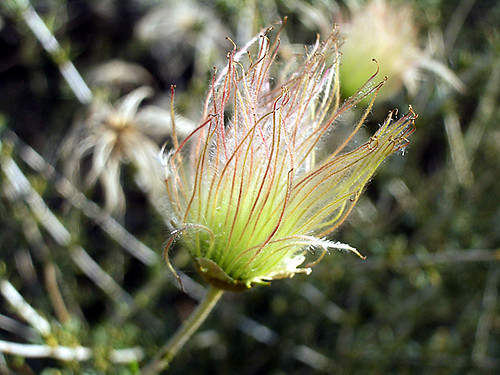
Apache Plume Fruit: photo by Cliff Hutson


Some years ago, I wrote a column called "Plant of the Month" for Oaks Notes the newsletter for the volunteers at Rancho Santa Ana Botanic Garden (now the California Botanic Garden). One of the pleasures I derived from writing those articles was that my research deepened my knowledge of the plants I picked for the column. Once, I was almost too ashamed to admit that I found out that what, for decades, I have taken to be the flower of Apache Plume was actually its fruit.

Apache Plume (Fallugia paradoxa) belongs to ROSACEAE, the rose family. It is native to the arid habitats of the mountains of east San Bernardino County. It is also found in the desert woodlands and scrub of Nevada, Utah, Arizona, Colorado, Texas, and northern Mexico. It is the only member of its genus. Which is to say it is monotypic. 

Apache Plume Flower: photo by Cliff Hutson


The flower of the shrub is roselike, or to some a little like an apple blossom, with rounded white petals and a center filled with many thready stamens and pistils. The flowers are small, but not inconspicuous if one really looks at the bush when preparing to write about it.

However, the persistent fruits have distinctive feathery plumes that look a lot like pompoms. They are formed when the ovary of the flower remains after the petals fall away, leaving the styles, each 3 to 5 centimeters long. Each style is attached to a fruit, which is a small achene. The plant is covered with these clusters. They are greenish at first, turning pink or reddish tinged later on.


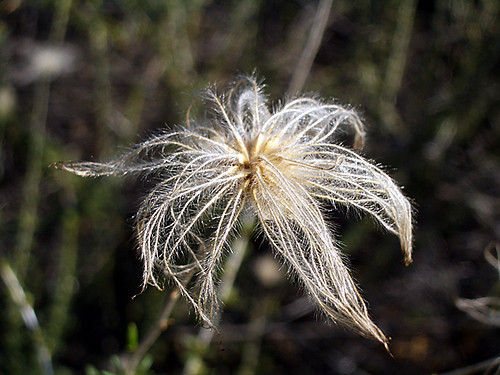
Eventually the plumes turn white and when backlit are quite spectacular. The fruit finally disperses when wind catches the styles and blows them away.


Apache Plume: photo by Cliff Hutson


The plant grows three to eight feet tall, with straw-colored branches and spreads six to eight feet. The small leaves are green on top and rusty underneath. Apache Plume can look a little scruffy, but still be attractive in a drought tolerant garden.


Monday, May 30, 2022

Potager Garden

A French Kitchen Garden


Radish: photo by Cliff Hutson

The French kitchen garden or potager, has mixed vegetables, fruits, flowers, and herbs dates back to medieval times. It is, at heart, basically an ornamental vegetable garden that is productive yet ornamental. Often flowers (edible and non-edible) and herbs are planted with the vegetables to enhance the beauty. The goal is to make the function of providing food aesthetically pleasing.

Plant What You'll Eat

A potager should be designed to bring beauty into the utilitarian food garden, so start by planting what you like to eat and cook.

These are some of the plants that we have used over the years:

Radishes

Garden Fresh: photo by Cliff Hutson


Radishes come in numerous varieties, varying in size, flavor, and color. They can be eaten fresh, roasted, sautéd, or pickled.

Basil

Basil: photo by Cliff Hutson

Basil is a fragrant herb that tastes great in many dishes—especially homemade pesto. 


Chile de Arbol Peppers
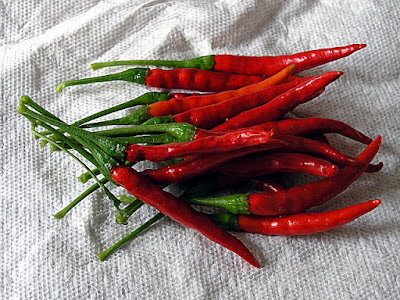

Chile de Arbol Peppers: photo by Cliff Hutson

Chile de Árbol means "tree chili" in Spanish, a name which refers to the woody stem of the pepper. They are small and thin Mexican peppers, growing to 2-3 inches long and less than a ½ inch wide. When they mature to a bright, vibrant red, they are ready to be used.

Chives


Chives in Flower: photo by Cliff Hutson


A perennial plant that is a small relative of the onion. The leaves and flowers are both edible. 

Eggplant 


Eggplant Basket: photo by Cliff Hutson


An annual vegetable, few vegetable plants are handsomer than eggplant. My favorite way to consume the fruit is Eggplant Parmesan.


Parsley

Bolted Parsley: photo by Cliff Hutson


Parsley is a popular herb often used in American, European, and Middle Eastern cooking. Not really all that attractive when it flowers, the leaves of many varieties can be quite ornamental as well as tasty.  Use them to elevate the flavor of dishes like soups, salads, and fish recipes.

Squash


Summer Squash: photo by Cliff Hutson


This edible annual comes in two forms:  Summer squash which is picked and cooked in an immature stage such as scalloped white squash, yellow crookneck, and zucchini. And, winter squash which have hard rinds. We prefer the former. 


Tomatoes

Tomatoes: photo by Cliff Hutson


The tomato is a gift to Europe from the "New World" as a part of the Columbian Exchange . (The Eastern Hemisphere got tomatoes, chili peppers, cacao, peanuts, and corn. The people living in the Americas got smallpox, measles, typhus, and cholera. But, that is another post.)

It is difficult for some of us to think of life without tomatoes. They may be the most widely grown garden plants edible or otherwise. As my Aunt Dagmar was won't to say, "There are only two things that money can't buy. One is true love. The other is homegrown tomatoes."


Tomato Flower: photo by Cliff Hutson


Monday, April 18, 2022

California Native Plant Week - 2022

 California Native Plant Week


California Poppy: photo by Cliff Hutson


California Native Plant Week began last Saturday, April 16, and will run through April 23rd. 

California is the most biologically and geographically diverse state in the United States. This makes for a large and diverse native flora. Southern California, the region that I am most familiar with, encompasses about 2,200 species of native vascular plants. (I have written about a few.) That is about half the flora occurring anywhere in the state, just to you some idea of what nature has in store.

No matter where you are,  check out what the California Native Plant Society is offering in celebration of this week. 


Five Spot: photo by Cliff Hutson


Earth Day


Earth Day is this coming Friday, April 22.  I would recommend observing it by going out and looking for native plants. But, here are some other suggested activities.

Monday, December 13, 2021

Nature Notes: Boojum

Boojum Tree 


"'But oh, beamish nephew, beware of the day,
If your Snark be a Boojum! For then
You will softly and suddenly vanish away,
 And never be met with again!”

“The Hunting of the Snark” by Lewis Carrol


Boojum Tree: photo by Cliff Hutson

Unlike Jack London, I have never had a Snark to call my own. Many years ago I considered buying one, but my wife pointed out that there was not enough room in my life for both a spouse and a sailboat, even a small one.  However, I have gazed upon the visage of a Boojum, many times and not vanished.

Fouquieria columnaris, or Boojum, is a tree in the same family as Ocotillo; Fouquieriaceae (Candlewood). The boojum is basically endemic to the Baja California Peninsula and parts of the Sonoran Desert, but can be considered as being in the California Floristic Province. Many say it resembles a slender upside-down carrot, up to 50 feet tall and about 1-1/2 feet wide at the base. It is covered with spiny twigs that bear whitish to yellowish flowers in hanging clusters during the Summer; and sometimes in the Fall.  As with ocotillo, its small leaves drop off in drier conditions, leaving the greenish stems to carry out photosynthesis.

Fouquieria is named for Pierre Éloi Fouquier (1776-1850), a French physician,  professor of medicine and naturalist. The epithet, columnaris means  “in the shape of a column”, referring to the stout upward tapering trunk. The common name of Boojum Tree was given by Godfrey Sykes of the Desert Botanical Laboratory in Tucson, Arizona. He apparently named it after the mythical being citied the nonsense poem written by Lewis Carroll, the pen name of Charles Lutwidge Dodgson.


Fouquieria columnaris: photo by Cliff Hutson
Fouquieria columnaris: photo by Cliff Hutson


Sadly, the extremely limited range of habitation of this impressive tree renders its continued survival a matter of great concern among many experts in spite of its being a protected species. They can found closer to home, for some of us. One place to visit a large collection is at the San Diego Zoo's Wild Animal Park. Other specimens are at the Desert Botanical Garden in Phoenix, the Huntington Botanical Gardens in San Marino, California, and the California Botanic Garden in Claremont, California.

Tuesday, June 23, 2020

National Pollinator Week 2020

The birds and the invertebrates


Ant: photo by Cliff Hutson

June 22-28, 2020 is National Pollinator Week.   It is an annual celebration of the many animals that move pollen to help plants make fruit or seeds.

While it is probably safe to say that most people readily identify honey bees as pollinators, many other creatures are also crucial to the lifecycle of plants.  It should not be a surprise that butterflies  and moths are among the usual suspects.  (Ants should probably be excluded, but I like my opening photograph so I am including it anyway.)

Butterfly Bush: photo by Cliff Hutson

Another thing that I find amusing is that much of the literature maintains that flower shape dictates the pollinators for a plant. Which is to say that flat flowers attract butterflies, cup shaped flowers bees, and tubular flowers humming birds. However, as I used to joke with my students, the animals do not read those papers. 

To wit, I can present bees  that are thinking outside of the box or perhaps they just have a rebellious nature.


Bee on California Sunflower; photo by Cliff Hutson


Bee & Camellia: photo by Cliff Hutson


Nevada Mining Bee: photo by Cliff Hutson

While Ladybugs are noted for eating aphids and other plant destroying pests, it seems that help in pollination as well.

Ladybug: photo by Cliff Hutson

Finally, this butterfly seems to be going by the book.

Painted Lady Butterfly: photo by Cliff Hutson

Pollinators are essential to our environment. The ecological service they provide is necessary for the reproduction of over 85% of the world’s flowering plants, including more than two-thirds of the world’s crop species.  

Here are some ways that we can help them to carry on:
  • Grow a variety of bee-friendly flowers that bloom from spring through fall.
  • Protect and provide bee nests and caterpillar host plants.
  • Avoid using pesticides, especially insecticides.


Wednesday, May 31, 2017

Matilija Poppy

Romneya coulteri


Romneya coulteri: photo by Cliff Hutson

Matilija Poppy, Romneya coulteri, is a perennial herb that is not only native to California but is endemic (limited) to California alone. It also has the distinction of being having the largest flower of any plant native to the state.  The flowers, up to seven inches in diameter, are said to resemble a fried egg as they are yellow in the center and surrounded by five or six white, crinkled petals. Its tall stems, with grayish-green leaves, may reach between three and eight feet in height.
This rampantly showy species, of the Papaveraceae family, is found in the chaparral and costal sage scrub habits. It should be blooming from May through June in the Peninsular Ranges and the eastern parts of the South Coast Ranges; at elevations of 20 - 1200 meters. Some blossoms may last well in to late Summer. Threatened by both development (urbanization, flood control, road widening, and road maintenance) and invasive species it is included in the CNPS Inventory of Rare and Endangered Plants on list 4.2 (limited distribution).
Matilija Poppy is very popular in native plant gardens. Care must be taken in its placement as it is rhizomatous and very aggressive in spreading itself through underground rootstocks which form additional colonies. It needs sun and tolerates various amounts of watering depending on how well the soil drains.
The scientific name commemorates Romney Robinson, an Irish astronomer of the 1800’s, and Thomas Coulter, an Irish physician, botanist, and explorer. The plant itself was almost honored. It was a nominee in 1890 for the title of state flower but lost to the California poppy ( Eschscholzia californica ) by an apparently considerable margin. However, I would like to demand a recount.
Matilija Poppy: photo by Cliff Hutson

SaveSaveSaveSaveSaveSaveSaveSave

Wednesday, March 22, 2017

First Day of Spring

A nice walk


I took a walk through the botanic garden on the first day of Spring. These plants captured my attention.

x Chiranthofremontia lenzii: photo by Cliff Hutson

Manzanita Berries: photo by Cliff Hutson

Berberis aquifolium 'Golden Abundance': photo by Cliff Hutson

SaveSave

Wednesday, November 16, 2016

Palo Verde

What's in a name?


Palo Verde: photo by Cliff Hutson
One of the things that intrigues me about leading tours at RSABG is the feed back I receive from guests. One plant that leads to many discussions is a tree we call Palo Verde. Everyone agrees that “verde” is Spanish for “green”. However, “palo” is variously translated as “stick”, “pole”, or “wood”. The “green” in its name comes from the color of the trunk and limbs which contain chlorophyll. This feature allows the tree to photosynthesize when it drops its leaves due to drought conditions, and again in winter.

Native to California, various specious of Palo Verde also occur throughout the Southwest and part of Mexico. They are found predominantly in desert washes, and occasionally in creosote desert scrub habitat, accessing seeps in desert hills up to 3,600 feet .

The most common species are: Little-leaved or Yellow Palo Verde (Parkinsonia aculeata) has a yellow-green trunk, tiny leaves, and a spine at the end of each branch. Their seeds are large with a seed pod that constricts around them; and Blue Palo Verde (Parkinsonia florida)  which has a blue-green trunk, larger leaves, small spines along the branch at the leaf nodes, and no spine at the end of the branch. Blue Palo Verde seed pods are larger than little-leaved seed pods, and the pod does not constrict around the seeds.

Palo Verde Blossoms: photo by Cliff Hutson
The yellow pea-like flowers bloom in spring and frequently occur intermittently through out the year. Both the literature and my personal observation indicate that the plant seems to attract the most bees and the most species of bees than any other tree. This factor, the sheer beauty of its filigreed leaves, and its low water requirement have made Palo Verde a popular landscape tree In our area.

Bee on Palo Verde: photo by Cliff Hutson


Wednesday, October 26, 2016

Apache Plume

Apache Plume Blossom: photo by Cliff Hutson

Apache Plume (Fallugia paradoxa) is a member of ROSACEAE, the rose family. It is native to California and found in the arid habitats of the mountains of east San Bernardino County. It is also grows in the desert woodlands and scrub of Nevada, Utah, Arizona, Colorado, Texas, and northern Mexico. It is the only member of its genus. Which is to say it is monotypic. 

The flower of the shrub is roselike, or to some a little like an apple blossom, with rounded white petals and a center filled with many thready stamens and pistils. The flowers are small, but not inconspicuous.

The persistent fruits have distinctive feathery plumes that look a lot like pompoms. They are formed when the ovary of the flower remains after the petals fall away, leaving the styles, each 3 to 5 centimeters long. Each style is attached to a fruit, which is a small achene. The plant is covered with these clusters. They are greenish at first, turning pink or reddish tinged later on.

Apache Plume Fruit: photo by Cliff Hutson

Eventually the plumes turn white and when backlit are quite spectacular. The fruit finally disperses when wind catches the styles and blows them away.

Apache Plume: photo by Cliff Hutson

The plant grows three to eight feet tall, with straw-colored branches and spreads six to eight feet. The small leaves are green on top and rusty underneath. Apache Plume can look a little scruffy, but still be attractive in a drought tolerant garden.
SaveSave