Showing posts sorted by relevance for query native plants. Sort by date Show all posts

Wednesday, September 21, 2016

Sunflowers

Coast Sunflower: photo by Cliff Hutson
Coast Sunflower (Encelia californica): photo by Cliff Hutson

The drought in California over the past five some odd years, and the resulting restrictions on watering, have been rough on home gardens, public plantings, and native plants. However, one plant that has been holding its own, at the botanic garden where I work, is one of the sunflowers.

Helianthus annuus 

Helianthus annuus, the common sunflower, is an annual herb that is native to California and is also found elsewhere in North America .  Sunflowers belong to the what is probably the largest family of flowering plants  - the Asteraceae (or Compositae). The name sunflower may derive from the impression that the blooming plant appears to slowly turn its flower towards the sun as the it moves across the sky, or from the shape of the flower which resembles a child’s drawing of the sun.

Sunflowers do display heliotropism in the bud stage. The motion is created by special cells in a flexible segment of the stem just below the bud. However, mature sunflowers become fixed in an easterly direction, with only their leaves continuing to track the sun. This motion, from east to west, is believed to increase photosynthesis.

The term Compositae, i.e., composite, comes from the fact that the “flower”’ is actually composed of many flowers. The flowers on the outer margin are ray flowers. The flowers at the center of the head are the disc flowers, which will mature into seeds. Many sunflowers are beautiful ornamental flowers in an annual bed or a mixed border. They attract bees and are also a good choice for butterfly gardens; monarch butterflies are especially attracted to sunflowers.

“Claremont Sunshine” Sunflower

Claremont Sunshine: photo by Cliff Hutson

RSABG is home to a cultivar of  Helianthus annuus, “Claremont Sunshine”, the plant that is doing pretty well.  Cultivars are bred from exceptional plants of an existing variety because they possess a desired attribute. I read that Bart O’Brien was driving on I-5 and spotted some wild sunflowers that were a very pale yellow, instead of the golden color. So he marked the spot, came back and harvested the seeds, then cultivated them. 

The Fall Planting Festival at Grow Native Nursery will showcase this and thousands of other California native and water efficient plants on October 1, 2016, 10 am - 4:30 pm - Members only, 8 -10 am. 

Rancho Santa Ana Botanic Garden has been selling California native plants since 1978. So, , if you are in Southern California, don’t miss this ideal opportunity to purchase hard-to-find, one-of-a-kind natives and to get your gardening questions answered by friendly, experienced botanic garden professionals and volunteers.

SaveSaveSaveSave
SaveSave

Monday, April 18, 2022

California Native Plant Week - 2022

 California Native Plant Week


California Poppy: photo by Cliff Hutson


California Native Plant Week began last Saturday, April 16, and will run through April 23rd. 

California is the most biologically and geographically diverse state in the United States. This makes for a large and diverse native flora. Southern California, the region that I am most familiar with, encompasses about 2,200 species of native vascular plants. (I have written about a few.) That is about half the flora occurring anywhere in the state, just to you some idea of what nature has in store.

No matter where you are,  check out what the California Native Plant Society is offering in celebration of this week. 


Five Spot: photo by Cliff Hutson


Earth Day


Earth Day is this coming Friday, April 22.  I would recommend observing it by going out and looking for native plants. But, here are some other suggested activities.

Wednesday, March 21, 2018

Spring Has Sprung

One of My Favorite Flowers


The calendar says that it is Spring. But, the weather says that it is "late Winter".  One of my favorite California native plants has been showing for a couple of weeks, as it can go either way.

As a naturalist, I like to have a theme in mind when I lead an interpretive walk. I see this as a means of engaging the audience’s interest, as opposed to just wandering around identifying plants until their eyes start to glaze over. One of the themes I use is “does the common name of this plant make sense”.  A favorite plant for this discussion is the Fairy Duster, Calliandra eriophylla. It takes little imagination to see that the fluffy pink blossoms do resemble feather dusters scaled down to fairy size, assuming we are thinking of Tinker Bell instead of Titania.


The flowers appear between late winter and late spring. They have dense clusters of pale to deep pink stamens and are about two inches wide. I think that they are quite attractive; and, in fact, Calliandra is derived from the Greek kallos, "beautiful," and andra, "stamen”. The leaves are also interesting being twice pinnately compound with each division bearing five to ten pairs of leaflets.

The plant, also known as False Mesquite, is a densely branched shrub, about two feet tall and twice as wide, native to western North America. A member of the Pea Family (Fabaceae), it belongs to a group of primarily tropical plants that include Acacias and Mimosas. However, Fairy Duster grows in sandy washes and on slopes in the arid desert and grasslands of California, Arizona, New Mexico and Texas; and Mexico.

But, to say it occurs in California is a bit misleading as it is found only in the Creosote Brush Scrub community and then seemingly limited to Imperial and San Diego Counties. Due to this geographic circumscription , it is included in the California Native Plant Society Inventory of Rare and Endangered Plants on list 2.3 (rare, threatened, or endangered in California; common elsewhere). In the interest of full disclosure, I would like to point out that one specimen was collected by Dr. Robert F. Thorne (of RSABG) on April 12, 1964, in Riverside County and that there is also a questionable 1881 accession from Kern County. I, myself, first encountered Fairy Duster while hiking in Riverside County. It was on land that was starting to be developed somewhere outside of Palm Springs, so it may not have been a natural occurrence.

Wherever we find it, I think it offers people an opportunity to ask people to look more carefully at nature and by observing this one flower they might go to focus on other aspects of nature rather than passively walk though it.

Wednesday, August 17, 2016

Holly in California?

Comarostaphylis diversifolia
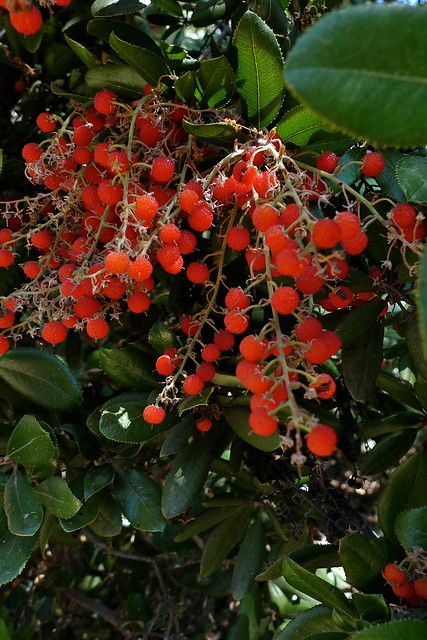
Summer Holly: photo by Cliff Hutson

Plants of the genus Ilex (Holly) are not native to California, though some may have naturalized. However, several of our native plants do have "holly" as part of their common names. This is no doubt due to their having pointy leaves and red berries, but in total disregard to their taxonomy. 

Summer holly (Comarostaphylis diversifolia) is found in coastal chaparral from Santa Barbara County southerly into Baja California. There may be populations on the Channel Islands as well. Some sources cite that the geography makes for two subspecies: Comarostaphylis diversifolia ssp. diversifolia in coastal Southern California and Baja; and Comarostaphylis diversifolia ssp. planifolia on the Channel Islands and the Transverse Ranges north of Los Angeles. It is not very common, but not yet listed as rare.

A slow‐growing, evergreen shrub or tree to 20 ft. tall. Attractive features include shiny leaves, white flowers, red berries and shredded bark. While the flowers are urn-shaped similar to the more familiar manzanita, the red berries are warty or wrinkly rather than smooth. That feature also distinguishes it from toyon. Summer holly is a member of Ericaceae, commonly known as the heath or heather family, a family of flowering plants found most commonly in acid and infertile growing conditions.

Summer Holly can be used in the home landscape. It does well in dry part shade and does not tolerate direct water in the summer. Some care must be taken, but one pay off is that birds are attracted to the fruit.
SaveSaveSaveSave

Thursday, April 16, 2020

California Native Plant Week #6

Joshua Tree


Joshua Tree Forest: photo by Cliff Hutson

While I am hesitant to once again write about a plant and perhaps draw too much attention to one of our over-pressured national parks, this tree is one of California's most iconic species.  

The park is named for the Joshua trees (Yucca brevifolia) native to the Mojave Desert, but it does occur outside those boundaries. And, sadly, some say that in the not too distant future it may no longer grow there.  

California Native Plant Week Takes a Different Turn This Year


A thoughtful essay from CNPS:  Native plants can offer hope, fun, and healthy distraction during stay-at-home orders.

Another way to connect with nature:  Birds


"Millions of people who aren’t frontline workers in the COVID-19 pandemic are adjusting to a new routine that means staying home — or close to it. Many are seeking solace outside."


But, wait, there's more!


There are plenty of other fun activities easy to enjoy while maintaining safe social distancing.

Monday, February 15, 2021

Fairy Duster


"In the end, we conserve only what we love. 

We will love only what we understand.

We will understand only what we are taught."


- Baba Dioum, Senegalese poet


Calliandra eriophylla


Fairy Duster: photo by Cliff Hutson

During the time that I worked as a naturalist, I liked to have a theme in mind when I led an interpretive walk. I saw this as a means of engaging the audience’s interest, as opposed to just wandering around identifying plants until their eyes glazed over. One of the themes I used was “does the common name of this plant make sense”.  A favorite plant for these discussions was the Fairy Duster, Calliandra eriophylla. It took  little imagination to see that the fluffy pink blossoms do rather resemble feather dusters scaled down to fairy size, assuming we are thinking of Tinker Bell instead of Titania.

The flowers appear between late winter and late spring. They have dense clusters of pale to deep pink stamens and are about two inches wide. I think that they are quite attractive; and, in fact, Calliandra is derived from the Greek kallos, "beautiful," and andra, "stamen”. The leaves are also interesting being twice pinnately compound with each division bearing five to ten pairs of leaflets.

The plant, also known as False Mesquite, is a densely branched shrub, about two feet tall and twice as wide, native to western North America. A member of the Pea Family (Fabaceae), it belongs to a group of primarily tropical plants that include Acacias and Mimosas. However, Fairy Duster grows in sandy washes and on slopes in the arid desert and grasslands of California, Arizona, New Mexico and Texas; and Mexico.

But, to say it occurs in California may be a bit misleading as it is found only in the Creosote Brush Scrub community and then seemingly limited to Imperial and San Diego Counties. Due to this geographic circumscription , it is included in the California Native Plant Society Inventory of Rare and Endangered Plants on list 2.3 (rare, threatened, or endangered in California; common elsewhere). In the interest of full disclosure, I would like to point out that one specimen was collected by Dr. Robert F. Thorne (of RSABG) on April 12, 1964, in Riverside County and that there is also a questionable 1881 accession from Kern County. I, myself, first encountered Fairy Duster while hiking in Riverside County. It was on land that was starting to be developed somewhere outside of Palm Springs, so it may not have been a natural occurrence.

Wherever we find it, I think it offers people an opportunity to ask people to look more carefully at nature and by observing this one flower they might go to focus on other aspects of nature rather than passively walk though it.

One is not going to value something they do not know and love.

Wednesday, May 31, 2017

Matilija Poppy

Romneya coulteri


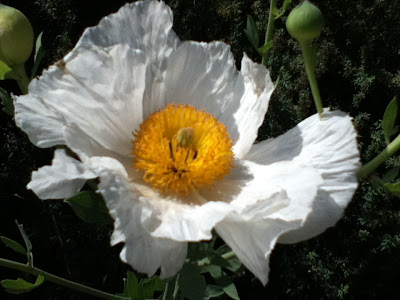
Romneya coulteri: photo by Cliff Hutson

Matilija Poppy, Romneya coulteri, is a perennial herb that is not only native to California but is endemic (limited) to California alone. It also has the distinction of being having the largest flower of any plant native to the state.  The flowers, up to seven inches in diameter, are said to resemble a fried egg as they are yellow in the center and surrounded by five or six white, crinkled petals. Its tall stems, with grayish-green leaves, may reach between three and eight feet in height.
This rampantly showy species, of the Papaveraceae family, is found in the chaparral and costal sage scrub habits. It should be blooming from May through June in the Peninsular Ranges and the eastern parts of the South Coast Ranges; at elevations of 20 - 1200 meters. Some blossoms may last well in to late Summer. Threatened by both development (urbanization, flood control, road widening, and road maintenance) and invasive species it is included in the CNPS Inventory of Rare and Endangered Plants on list 4.2 (limited distribution).
Matilija Poppy is very popular in native plant gardens. Care must be taken in its placement as it is rhizomatous and very aggressive in spreading itself through underground rootstocks which form additional colonies. It needs sun and tolerates various amounts of watering depending on how well the soil drains.
The scientific name commemorates Romney Robinson, an Irish astronomer of the 1800’s, and Thomas Coulter, an Irish physician, botanist, and explorer. The plant itself was almost honored. It was a nominee in 1890 for the title of state flower but lost to the California poppy ( Eschscholzia californica ) by an apparently considerable margin. However, I would like to demand a recount.
Matilija Poppy: photo by Cliff Hutson

SaveSaveSaveSaveSaveSaveSaveSave

Monday, March 23, 2015

Fun with Words

Wordle


Sometimes Wordle works for me. Sometimes it don't. This example was generated from a very small sampling of my Plant of the Month articles.

Wordle is a tool for generating “word clouds” from text that you provide. It should also work from a RSS feed, but that was not cutting it for me tonight. The clouds give greater prominence to words that appear more frequently in the source text. And, it proves out that when one writes about the native plants of California, the name of the state will be very eminent.

You can tweak your clouds with different fonts, layouts, and color schemes. The images you create with Wordle are yours to use however you like. You can print them out, or save them to your own desktop to use as you wish.

Wednesday, March 11, 2015

Heuchera

Coral Bells

Coral Bells
"Coral Bells": photo by Cliff Hutson

Heucheras, also known as Alumroot or Coral Bells, are North American plants characterized by clumps of low dark green round or heart-shaped leaves and slender stems of small urn-shaped flowers, ranging from white to scarlet. A member of the Saxifragaceae – Saxifrage family, the USDA plants data base recognizes 37 species, about a third of which are found in California. Of these, eight are endemic (limited) to the state, e.g., Heuchera pilosissima.

Heucheras are frequently touted as drought-tolerant evergreen perennial plants that like filtered sunlight or shade. But, many California native varieties are adapted to a more rugged life. One citation states that they live in cracks in rocks where they bake in the sun, "and when rains come, they bloom their heads off." Saxifra'ga: is from the Latin saxum, "a rock," and frango, "to break," - referring to the fact that by growing in rock crevices they appear to break rocks. However, others do prefer a more gentle seaside climate and like regular water if planted in a garden.

Linnaeus named the genus for Johann Heinrich von Heucher (1677-1747), professor of medicine and Botany at Wittenberg University. It was stated that the name Heuchera should be pronounced following the person's name it commemorates so the proper pronunciation is HOY-ker-uh. But, I pronounce it as HEW-ker-uh as that is the way I first heard it, in my mind anyway.

At the botanic garden where I work, heucheras, most of which appear to be some shade of pink, do well in masses under oak tree canopies.  A noted horticulturist has said. "Full sun through the winter is fine and makes them bloom well, but they need shade during the summer, especially this far inland."

Monday, June 13, 2022

Nature Notes: Datura

 Toloache

A plant of many names.


Toloache: photo by Cliff Hutson

Datura wrightii


Datura, the name I first learned, is a member of the Nightshade family (Solanaceae) and is not uncommon from Central California to northern Mexico and east across the Southwest to Texas. It is, in fact fairly common in the foothills north of my home. So you may imagine my surprise that two of my field guides: "Introduction to California Chaparral" and "Introduction to the Plant Life of Southern California: Coast to Foothills" fail to mention it.

Perhaps this is due to the plant’s seedy reputation. Easily recognized by its trumpet-shaped flowers , it has been used for hundreds of years for its hallucinogenic properties. However, it is as toxic as it is narcotic and has been responsible for the deaths of some seeking to use it for its traditional religious purposes; or more likely, recreation.

Like many Americans of my generation, I first learned of the properties of Datura, also called Jimsonweed, through reading Carlos Castaneda’s "The Teachings of Don Juan". His purported experiences led many to go out and try it for themselves. Surprisingly, I never did.

I say surprisingly as I have gone through what I called a Euell Gibbons phase and have an abiding interest in ethnobotany, as evidenced by my work at Rancho Santa Ana Botanic Garden. These pursuits have led me to consume more than a few native plants of California. But, I have a healthy respect for for things that might kill me if I do not know what I am doing and figure to give Datura a permanent pass.

The book "California Indians and Their Environment: An Introduction" by Kent G. Lightfoot and Otis Parish has a few interesting entries on what they call Toloache. They describe religious uses, such as gaining the ability to transcend reality, and medicinal purposes. Some groups prepared it in a drink as a painkiller and a treatment for a variety of ailments.

Speaking of names, the "National Audubon Society Field Guide to North American Wildflowers" refers to the plant as Southwestern Thorn Apple. It says that the common name Jimsonweed is a corruption of Jamestown Weed. The story goes that it got the name when many soldiers sent to quell Bacon’s rebellion in 1676 were poisoned by it.

Jimsonweed


Jimsonweed: photo by Cliff Hutson

By the way, the flower is typically white (see above), but  may be some times tinged with violet, as shown in the lead photograph.


Monday, April 17, 2023

California Native Plant Week - 2023

Celebrating Eight Days a Week


California Poppy: photo by Cliff Hutson


This year, California Native Plant Week runs from April 15 thorough April 22 (Earth Day).  The state is one of the most biodiverse regions on the planet with more than 6,000 types of plants. I thought that I would share some photos of some of my favorites (in no particular order). 


Five Spot: photo by Cliff Hutson


California Bay: photo by Cliff Hutson


Datura: photo by Cliff Hutson


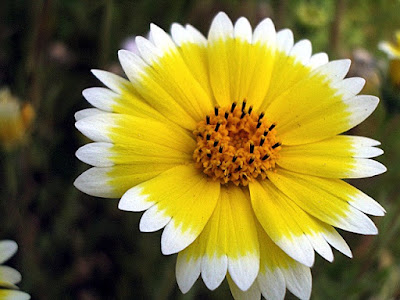
Tidy Tips: photo by Cliff Hutson


Flannel Bush: photo by Cliff Hutson


Matilija Poppy: photo by Cliff Hutson


Shaw's Agave: photo by Cliff Hutson


Sticky Monkey Flower: photo by Cliff Hutson


Wednesday, April 17, 2019

Wildflower Week

RSABG Badge: photo by Cliff Hutson

Wildflower Week


This past weekend kicked off Wildflower Week at the the botanic garden where I work. This prompted me to muse about one of my personal favorites.

Hooker’s Evening Primrose


Oenothera elata hookeri: photo by Cliff Hutson

Hooker’s evening primrose, Oenothera elata hookeri, is a member of a genus of about 145 species of herbaceous flowering plants native to the Americas. It is the type genus of the family Onagraceae. Common names include evening primrose, suncups, and sundrops.

The appellation “evening” comes from the habit of the blooms of many species opening in twilight. An interesting aspect of evening primroses is that their flowers open very quickly, some in under a minute. This occurs because the cells at the margins of the sepals are connected in a zipper-like structure. As the petals grow, they break through the zipper and quickly spill out.

The hookeri subspecies is native to California and also grows in much of western and central North America. It is tall for an evening primrose, reaching heights of up to six feet. It flowers from June through September with yellow blossoms that are 2 to 3 inches wide. One of the most distinctive features of the flower is the stigma, which has four branches in an X shape.

Calflora says that this plant generally inhabits moist places in coastal or somewhat inland areas at lower elevations. Other sources state that it can be found on open slopes, road banks, and grassy areas from the plains to the mountains. One nursery, which carries it, maintains that it will survive drought and flooding, sun, wind and cold.

The common name always seemed a bit risqué to me. But, it is actually named for Sir William Jackson Hooker (1785-1865), professor of botany and director of the Royal Botanical Gardens at Kew in the mid 19th century and author of several botanical works. Among his friends and colleagues were David Douglas, Thomas Nuttall, and Asa Gray, after whom he named the genus Grayia. How is that for name dropping?


Monday, March 22, 2021

Hoary-leaved Ceanothus

Hoary-leaved Ceanothus


Hoary-leaved Ceanothus: photo by Cliff Hutson


hoary |ˈhôrÄ“|
adjective ( hoarier , hoariest )
1 grayish-white : hoary cobwebs.
• (of a person) having gray or white hair; aged : a hoary old fellow with a face of white stubble.
  • [ attrib. ] used in names of animals and plants covered with whitish fur or short hairs, e.g., hoary bat, hoary cress.


A Hoary Leaf: photo by Cliff Hutson


There are at least 52 species of ceanothus in the world. California is home to 43 species, sometimes known as California lilac, and 13 of these are native to the chaparral of Southern California. The dominant species in our local, lower-elevation, Santa Monica Mountains is Bigpod Ceanothus, Ceanothus megacarpus. However, at higher elevations it is replaced  Ceanothus crassifolius, Hoary-leaved Ceanothus. 

Plants in the genus Ceanothus are divided in to two groups - the subgenus Ceanothus and the subgenus Cerastes. The later is actually the larger group. But, I think that most of us, thanks to its showy displays, are more familiar with the former which is characterized by thin leaves that have three main veins, arrayed alternately on the stems. The leaves of Cerastes are leathery with a single main vein, and generally opposite in arrangement. 

A member of the Buckthorn family (Rhamnaceae) it is a large, evergreen shrub which may grow to twelve feet in height.  The leathery olive green leaves have white fuzzy undersides, which makes them hoary. The field guides I use describe the leaves as being “small”, which seemed a bit vague.  An internet gardening catalog stated they they are 1/4­ to 1/2" long. However, I took some measurements on a specimen at Rancho Santa Ana Botanic Garden and found them to be closer to 1-1 1/2”. Which reminds me of the old taunt - “Who are going to believe, the facts or your lying eyes?” The small (truly about a quarter of an inch), rounded flowers are white with the inflorescences borne on short stalks.

Hoary-leaved Ceanothus is distributed through the Outer South Coast Range, Transverse Range, Peninsular Range, and Northern Baja on dry ridges or slopes below 3700'. Which is to say locally we can find it in the Verdugo, San Gabriel, Santa Monica and San Bernardino Mountains.


Thursday, December 3, 2015

California Juniper

Juniperus californica


 (Juniperus californica)
California Juniper: photo by Cliff Hutson


California Juniper is a shrub-like tree that is native to California and is found only slightly beyond California’s borders; a short distance into the Great Basin in southern Nevada, northwestern Arizona, and Baja California. Throughout our state it is found in the Peninsular Ranges, Transverse Ranges, California Coast Ranges, Sacramento Valley foothills, Sierra Nevada, and at higher elevation sky islands in the Mojave Desert ranges in Pinyon-Juniper Woodland, Joshua Tree Woodland, and Foothill Woodland communities. It is a member of the Cupressaceae or cypress family

The plant can grow to forty feet in height, but is usually much shorter (10-15 ft.). The leaves are scalelike, and yellow-green in color.  The bark is ashy gray to brown, and furrowed or shredded in appearance. The “berries” are actually cones (7–12 mm) which are described as bluish (although they look greenish to me), with a bloom, and contain one or two seeds. The cones are red-brown when dry. California juniper is said to be dioecious, producing cones of only one sex on an individual plant. But a small percentage of plants are monoecious, i.e., both sexes on the same plant.

Juniperus californica provides food and shelter for a variety of mammals and birds. Notably, it is a larval host for the native moth Sequoia sphinx (Sphinx sequoiae). It is popular species for bonsai; and also has value as an ornamental being drought-tolerant and requiring no water after it is established.

Indigenous people used the wood for sinew-backed bows. South Coast Province people also ground up the cones and molded them into cakes, which were said to taste sweet. It is reported that other groups ate the berries fresh or prepared them as a mush. A medical decoction was also used to treat rheumatism and urinary problems. 

Wednesday, November 30, 2016

California Dodder


California Dodder: photo by Cliff Hutson
The astute reader of this blog may recall that I am a Nature Interpreter at Rancho Santa Ana Botanic Garden (RSABG) and lead tours for school children and adults. It was also my pleasure to have written the “Plant of the Month” article for “Oak Notes”, an in-house newsletter, for four years.

One of the sites I refer to, among the usual suspects such as Wikipedia and CNPS, when writing about a plant is maintained by the Consortium of California Herbaria  which provides information about California vascular plant specimens that are housed in participant herbaria. One can search on just about any plant and obtain a list of accessions from around the state.


California Dodder (Cuscuta californica), hits close to home as it has records dating from 1897 to 2009 for specimens found in and around Claremont. Two of these are housed in the RSABG herbarium. One was collected from the Bernard Field Station, just to the east. The other was found along Thompson Creek where I often see the plant.

Cuscuta californica, also called Chaparral Dodder, is an annual parasitic herb or vine that is native to California. It is also found outside of California, but is confined to western North America. Dodder is readily identified by its threadlike, hairless, yellow, orange, or red shoots which twine around host plants eventually creating a tangled mat. One notable feature is that it does not usually have roots that reach the ground. Instead, knoblike organs along the shoot (haustoria) penetrate the host stem. Shoots either lack leaves or have very tiny red, yellow, or orange scalelike leaves pressed close to the stem. It tends to bloom from May through October. The white flowers are tiny, only about 3 to 6 millimeters wide. The fruits are even smaller.

Dodder once had its own family, but it is now consigned to CONVOLVULACEAE, the Morning Glory Family. The epithet Cuscuta seemingly comes from Cuscu'ta a name of Arabic derivation meaning "dodder”. The common name, Chaparral Dodder, tips us to one of its habitats. It is also found through out the state in many other plant communities such as forests and grasslands. And, of course, “the City of Trees and PhDs”.
SaveSaveSaveSaveSaveSaveSaveSaveSaveSave

Wednesday, May 25, 2016

Sticky Monkeyflower

Orange Bush Monkeyflower


Sticky Monkeyflower: photo by Cliff Hutson

The author Elmore Leonard  gave the advice that a writer should never open with the weather. So, I am not going to talk about the drought in California and how it has played havoc with the list of plants I intended to write about this year. However, one of them has held its own.

Orange Bush Monkeyflower, or Sticky Monkeyflower, Diplacus aurantiacus (aka Mimulus aurantiacus), is a plant that is native to California and is found only slightly beyond our borders. It is common in disturbed areas of coastal sage scrub, and also found in the chaparral and live oak woodland communities. It is fairly abundant in my local foothills, so it is a personal favorite when it comes to wildflowers.

Once placed in the Scrophulariaceae (Figwort family), most references now have it in the Phrymaceae (Lopseed family). It is a perennial shrub which flowers March through June. The blossoms are two to three inches long and can be white, yellow, or red; as well as the namesake orange. The name monkeyflower comes from the flowers which, some say, look, like small faces when viewed from the front.  I have never seen a face. May be it is a lack of imagination on my part, but I am willing to take their word for it. The leaves are one to two inches long, dark green with deeply impressed veins, and are sticky to the touch. The stickiness is due to a phenolic resin which helps the plant retain water in dry environments.

The plant is shrubby and may be sprawling, but can grow to four feet tall. It is attractive to bees and hummingbirds; in Southern California, monkeyflower's most frequent visitors are Anna’s hummingbirds and Allen’s hummingbirds. Also, it is a forage source for the larva of Variable Checkerspot and Common Buckeye butterflies.

Birds, bees, and butterflies help make our world function. I am not a gardener, but I am tempted to plant a few of these monkeyflowers at home to help make up for the huge hit these creatures have taken due to changes in their habitats.