Showing posts with label RSABG. Show all posts

Monday, October 3, 2022

Apache Plume

Apache Plume

Apache Plume Fruit: photo by Cliff Hutson


Some years ago, I wrote a column called "Plant of the Month" for Oaks Notes the newsletter for the volunteers at Rancho Santa Ana Botanic Garden (now the California Botanic Garden). One of the pleasures I derived from writing those articles was that my research deepened my knowledge of the plants I picked for the column. Once, I was almost too ashamed to admit that I found out that what, for decades, I have taken to be the flower of Apache Plume was actually its fruit.

Apache Plume (Fallugia paradoxa) belongs to ROSACEAE, the rose family. It is native to the arid habitats of the mountains of east San Bernardino County. It is also found in the desert woodlands and scrub of Nevada, Utah, Arizona, Colorado, Texas, and northern Mexico. It is the only member of its genus. Which is to say it is monotypic. 

Apache Plume Flower: photo by Cliff Hutson


The flower of the shrub is roselike, or to some a little like an apple blossom, with rounded white petals and a center filled with many thready stamens and pistils. The flowers are small, but not inconspicuous if one really looks at the bush when preparing to write about it.

However, the persistent fruits have distinctive feathery plumes that look a lot like pompoms. They are formed when the ovary of the flower remains after the petals fall away, leaving the styles, each 3 to 5 centimeters long. Each style is attached to a fruit, which is a small achene. The plant is covered with these clusters. They are greenish at first, turning pink or reddish tinged later on.


Eventually the plumes turn white and when backlit are quite spectacular. The fruit finally disperses when wind catches the styles and blows them away.


Apache Plume: photo by Cliff Hutson


The plant grows three to eight feet tall, with straw-colored branches and spreads six to eight feet. The small leaves are green on top and rusty underneath. Apache Plume can look a little scruffy, but still be attractive in a drought tolerant garden.


Monday, February 15, 2021

Fairy Duster


"In the end, we conserve only what we love. 

We will love only what we understand.

We will understand only what we are taught."


- Baba Dioum, Senegalese poet


Calliandra eriophylla


Fairy Duster: photo by Cliff Hutson

During the time that I worked as a naturalist, I liked to have a theme in mind when I led an interpretive walk. I saw this as a means of engaging the audience’s interest, as opposed to just wandering around identifying plants until their eyes glazed over. One of the themes I used was “does the common name of this plant make sense”.  A favorite plant for these discussions was the Fairy Duster, Calliandra eriophylla. It took  little imagination to see that the fluffy pink blossoms do rather resemble feather dusters scaled down to fairy size, assuming we are thinking of Tinker Bell instead of Titania.

The flowers appear between late winter and late spring. They have dense clusters of pale to deep pink stamens and are about two inches wide. I think that they are quite attractive; and, in fact, Calliandra is derived from the Greek kallos, "beautiful," and andra, "stamen”. The leaves are also interesting being twice pinnately compound with each division bearing five to ten pairs of leaflets.

The plant, also known as False Mesquite, is a densely branched shrub, about two feet tall and twice as wide, native to western North America. A member of the Pea Family (Fabaceae), it belongs to a group of primarily tropical plants that include Acacias and Mimosas. However, Fairy Duster grows in sandy washes and on slopes in the arid desert and grasslands of California, Arizona, New Mexico and Texas; and Mexico.

But, to say it occurs in California may be a bit misleading as it is found only in the Creosote Brush Scrub community and then seemingly limited to Imperial and San Diego Counties. Due to this geographic circumscription , it is included in the California Native Plant Society Inventory of Rare and Endangered Plants on list 2.3 (rare, threatened, or endangered in California; common elsewhere). In the interest of full disclosure, I would like to point out that one specimen was collected by Dr. Robert F. Thorne (of RSABG) on April 12, 1964, in Riverside County and that there is also a questionable 1881 accession from Kern County. I, myself, first encountered Fairy Duster while hiking in Riverside County. It was on land that was starting to be developed somewhere outside of Palm Springs, so it may not have been a natural occurrence.

Wherever we find it, I think it offers people an opportunity to ask people to look more carefully at nature and by observing this one flower they might go to focus on other aspects of nature rather than passively walk though it.

One is not going to value something they do not know and love.

Wednesday, April 17, 2019

Wildflower Week

RSABG Badge: photo by Cliff Hutson

Wildflower Week


This past weekend kicked off Wildflower Week at the the botanic garden where I work. This prompted me to muse about one of my personal favorites.

Hooker’s Evening Primrose


Oenothera elata hookeri: photo by Cliff Hutson

Hooker’s evening primrose, Oenothera elata hookeri, is a member of a genus of about 145 species of herbaceous flowering plants native to the Americas. It is the type genus of the family Onagraceae. Common names include evening primrose, suncups, and sundrops.

The appellation “evening” comes from the habit of the blooms of many species opening in twilight. An interesting aspect of evening primroses is that their flowers open very quickly, some in under a minute. This occurs because the cells at the margins of the sepals are connected in a zipper-like structure. As the petals grow, they break through the zipper and quickly spill out.

The hookeri subspecies is native to California and also grows in much of western and central North America. It is tall for an evening primrose, reaching heights of up to six feet. It flowers from June through September with yellow blossoms that are 2 to 3 inches wide. One of the most distinctive features of the flower is the stigma, which has four branches in an X shape.

Calflora says that this plant generally inhabits moist places in coastal or somewhat inland areas at lower elevations. Other sources state that it can be found on open slopes, road banks, and grassy areas from the plains to the mountains. One nursery, which carries it, maintains that it will survive drought and flooding, sun, wind and cold.

The common name always seemed a bit risqué to me. But, it is actually named for Sir William Jackson Hooker (1785-1865), professor of botany and director of the Royal Botanical Gardens at Kew in the mid 19th century and author of several botanical works. Among his friends and colleagues were David Douglas, Thomas Nuttall, and Asa Gray, after whom he named the genus Grayia. How is that for name dropping?


Wednesday, October 31, 2018

The Shoe Designer

“Hey, I put some new shoes on
And suddenly everything is right”
 - Songwriters: Jim Duguid / Mathew William Benbrook / Matt Benbrook / Paolo Giovanni Nutini

New Shoes


"Outdoor Chill" Laces: photo by Cliff Hutson

Who amongst us does not enjoy a pair of new shoes?  I know that I do and I recently got to design them as well, basically from scratch. 

Chuck Taylor All-Stars


Inner Body: photo by Cliff Hutson

Chuck Taylor All-Stars were one of the most iconic shoes of my youth. Times were simpler then, so we had a choice of two - black or white; as I recall. However, as with most other things, that palette has significantly expanded.  Now, I even have a pair with wool uppers in black and white plaid that Converse created in a partnership with Woolrich.   

Feeling the need for another pair of shoes to wear at work, I was going to buy a plain classic model when I discovered that one could actually create a customized version of their very own. Thus I was launched into the world of shoe design.

Blank Canvas


Blank Canvas: photo by Cliff Hutson

The driving force behind my design is that my go to work "uniform"is a green shirt, and that I wear a walnut colored Stetson in cool weather. Rightly or wrongly, I decided that it would be fun to have the shoes reflect this. 

Outer Body: photo by Cliff Hutson

Thus the outer body is green and the inner body is brown.

Both Sides Now: photo by Cliff Hutson

Was very conservative with the remaining twelve (12!) options, leaning to what I felt was traditional. That is except for the laces.

Finished Product


New Shoes: photo by Cliff Hutson

The laces are described as "Outdoor Chill". When I saw that name I just kind of automatically clicked on that choice. They are wilder than I thought they would be; and I am not sure where the "chill" enters in to it. However, they, of course, can be easily switched out if I grow tired of them.

Other than that I am very pleased with my creation.


Wednesday, March 21, 2018

Spring Has Sprung

One of My Favorite Flowers


The calendar says that it is Spring. But, the weather says that it is "late Winter".  One of my favorite California native plants has been showing for a couple of weeks, as it can go either way.

As a naturalist, I like to have a theme in mind when I lead an interpretive walk. I see this as a means of engaging the audience’s interest, as opposed to just wandering around identifying plants until their eyes start to glaze over. One of the themes I use is “does the common name of this plant make sense”.  A favorite plant for this discussion is the Fairy Duster, Calliandra eriophylla. It takes little imagination to see that the fluffy pink blossoms do resemble feather dusters scaled down to fairy size, assuming we are thinking of Tinker Bell instead of Titania.


The flowers appear between late winter and late spring. They have dense clusters of pale to deep pink stamens and are about two inches wide. I think that they are quite attractive; and, in fact, Calliandra is derived from the Greek kallos, "beautiful," and andra, "stamen”. The leaves are also interesting being twice pinnately compound with each division bearing five to ten pairs of leaflets.

The plant, also known as False Mesquite, is a densely branched shrub, about two feet tall and twice as wide, native to western North America. A member of the Pea Family (Fabaceae), it belongs to a group of primarily tropical plants that include Acacias and Mimosas. However, Fairy Duster grows in sandy washes and on slopes in the arid desert and grasslands of California, Arizona, New Mexico and Texas; and Mexico.

But, to say it occurs in California is a bit misleading as it is found only in the Creosote Brush Scrub community and then seemingly limited to Imperial and San Diego Counties. Due to this geographic circumscription , it is included in the California Native Plant Society Inventory of Rare and Endangered Plants on list 2.3 (rare, threatened, or endangered in California; common elsewhere). In the interest of full disclosure, I would like to point out that one specimen was collected by Dr. Robert F. Thorne (of RSABG) on April 12, 1964, in Riverside County and that there is also a questionable 1881 accession from Kern County. I, myself, first encountered Fairy Duster while hiking in Riverside County. It was on land that was starting to be developed somewhere outside of Palm Springs, so it may not have been a natural occurrence.

Wherever we find it, I think it offers people an opportunity to ask people to look more carefully at nature and by observing this one flower they might go to focus on other aspects of nature rather than passively walk though it.

Wednesday, March 22, 2017

First Day of Spring

A nice walk


I took a walk through the botanic garden on the first day of Spring. These plants captured my attention.

x Chiranthofremontia lenzii: photo by Cliff Hutson

Manzanita Berries: photo by Cliff Hutson

Berberis aquifolium 'Golden Abundance': photo by Cliff Hutson

SaveSave

Wednesday, November 30, 2016

California Dodder


California Dodder: photo by Cliff Hutson
The astute reader of this blog may recall that I am a Nature Interpreter at Rancho Santa Ana Botanic Garden (RSABG) and lead tours for school children and adults. It was also my pleasure to have written the “Plant of the Month” article for “Oak Notes”, an in-house newsletter, for four years.

One of the sites I refer to, among the usual suspects such as Wikipedia and CNPS, when writing about a plant is maintained by the Consortium of California Herbaria  which provides information about California vascular plant specimens that are housed in participant herbaria. One can search on just about any plant and obtain a list of accessions from around the state.


California Dodder (Cuscuta californica), hits close to home as it has records dating from 1897 to 2009 for specimens found in and around Claremont. Two of these are housed in the RSABG herbarium. One was collected from the Bernard Field Station, just to the east. The other was found along Thompson Creek where I often see the plant.

Cuscuta californica, also called Chaparral Dodder, is an annual parasitic herb or vine that is native to California. It is also found outside of California, but is confined to western North America. Dodder is readily identified by its threadlike, hairless, yellow, orange, or red shoots which twine around host plants eventually creating a tangled mat. One notable feature is that it does not usually have roots that reach the ground. Instead, knoblike organs along the shoot (haustoria) penetrate the host stem. Shoots either lack leaves or have very tiny red, yellow, or orange scalelike leaves pressed close to the stem. It tends to bloom from May through October. The white flowers are tiny, only about 3 to 6 millimeters wide. The fruits are even smaller.

Dodder once had its own family, but it is now consigned to CONVOLVULACEAE, the Morning Glory Family. The epithet Cuscuta seemingly comes from Cuscu'ta a name of Arabic derivation meaning "dodder”. The common name, Chaparral Dodder, tips us to one of its habitats. It is also found through out the state in many other plant communities such as forests and grasslands. And, of course, “the City of Trees and PhDs”.
SaveSaveSaveSaveSaveSaveSaveSaveSaveSave

Wednesday, September 21, 2016

Sunflowers

Coast Sunflower: photo by Cliff Hutson
Coast Sunflower (Encelia californica): photo by Cliff Hutson

The drought in California over the past five some odd years, and the resulting restrictions on watering, have been rough on home gardens, public plantings, and native plants. However, one plant that has been holding its own, at the botanic garden where I work, is one of the sunflowers.

Helianthus annuus 

Helianthus annuus, the common sunflower, is an annual herb that is native to California and is also found elsewhere in North America .  Sunflowers belong to the what is probably the largest family of flowering plants  - the Asteraceae (or Compositae). The name sunflower may derive from the impression that the blooming plant appears to slowly turn its flower towards the sun as the it moves across the sky, or from the shape of the flower which resembles a child’s drawing of the sun.

Sunflowers do display heliotropism in the bud stage. The motion is created by special cells in a flexible segment of the stem just below the bud. However, mature sunflowers become fixed in an easterly direction, with only their leaves continuing to track the sun. This motion, from east to west, is believed to increase photosynthesis.

The term Compositae, i.e., composite, comes from the fact that the “flower”’ is actually composed of many flowers. The flowers on the outer margin are ray flowers. The flowers at the center of the head are the disc flowers, which will mature into seeds. Many sunflowers are beautiful ornamental flowers in an annual bed or a mixed border. They attract bees and are also a good choice for butterfly gardens; monarch butterflies are especially attracted to sunflowers.

“Claremont Sunshine” Sunflower

Claremont Sunshine: photo by Cliff Hutson

RSABG is home to a cultivar of  Helianthus annuus, “Claremont Sunshine”, the plant that is doing pretty well.  Cultivars are bred from exceptional plants of an existing variety because they possess a desired attribute. I read that Bart O’Brien was driving on I-5 and spotted some wild sunflowers that were a very pale yellow, instead of the golden color. So he marked the spot, came back and harvested the seeds, then cultivated them. 

The Fall Planting Festival at Grow Native Nursery will showcase this and thousands of other California native and water efficient plants on October 1, 2016, 10 am - 4:30 pm - Members only, 8 -10 am. 

Rancho Santa Ana Botanic Garden has been selling California native plants since 1978. So, , if you are in Southern California, don’t miss this ideal opportunity to purchase hard-to-find, one-of-a-kind natives and to get your gardening questions answered by friendly, experienced botanic garden professionals and volunteers.

SaveSaveSaveSave
SaveSave

Monday, March 23, 2015

Fun with Words

Wordle


Sometimes Wordle works for me. Sometimes it don't. This example was generated from a very small sampling of my Plant of the Month articles.

Wordle is a tool for generating “word clouds” from text that you provide. It should also work from a RSS feed, but that was not cutting it for me tonight. The clouds give greater prominence to words that appear more frequently in the source text. And, it proves out that when one writes about the native plants of California, the name of the state will be very eminent.

You can tweak your clouds with different fonts, layouts, and color schemes. The images you create with Wordle are yours to use however you like. You can print them out, or save them to your own desktop to use as you wish.

Thursday, January 1, 2015

The Books I Read in 2014

The idea for a monthly photographic record of what books I read was inspired by the work of David Allen, a columnist for my local paper. But, it did not hit me until I was well into February and by then January was lost in the fog of time.  Therefore, this starts with the books I use all year long either on my rambles or as a resource for the "Plant of the Month" article I write for the Rancho Santa Ana Botanic Garden publication Oak Notes.

I also decided, taking a page from Kenton Nelson, not to describe each book. The reader of this blog can decide what to think about me or my choices. 


Reference

February

March

April

May

June

July

August

September

October

November

December

Sunday, October 13, 2013

Introverts on Twitter


He who travels fastest travels alone.


Wednesday, March 26, 2008

Spring Garden Walks


Fay's Meadow
Originally uploaded by The Marmot
This is my favorite time of the year. The wildflowers are in bloom, and as a tour leader I have a built in excuse to be at Rancho Santa Ana Botanic Garden almost every weekend.

RSABG, as it is known in shorthand, is one of Claremont's best treasures. A hidden treasure to many people. Tucked away at the very end of College Avenue, north of Foothill, it can be easy to miss. But, it is well worth the finding.

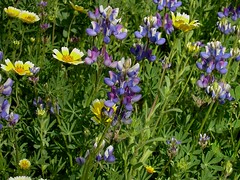
The tours give us an opportunity to take visitors around the grounds to view and interpret the wildflowers and other plant collections. The bloom is pretty good this year. The Lupines and Tidy Tips are coming in to their own. Most of the Ceanothus, Western Redbuds, and Flannelbush are spectacular.

So, if you have the time, come on over any Saturday or Sunday at 2:00 p.m. from now until May 18.

Wednesday, January 23, 2008

Storytelling


Arborday Visitors
Originally uploaded by The Marmot
Stories, such as narratives, myths, and fables, amount to a strong medium of exchange in human relationships. Stories speak to both parts of the human mind - its reason and its emotion. They can inspire and motivate people as they provide a tool for putting vision in to words. Stories can serve as a means for learning and communicating. They provide a powerful mechanism for capturing and leveraging knowledge, one that is complementary to logical thinking, or what we think of as "just the facts."

Fairhurst and Sarr(1996), in their book on framing, further explain, "Effective leaders present the world with images that grab our attention and interest. They use language in ways that allow us to see leader-ship not only as big decisions but as a series of moments in which images build upon each other to help us construct a reality to which we must then respond."

It has long been a practice of mine to mix personal or humorous stories in to almost all my presentations I make for work. Actually, I have become somewhat famous (or infamous) for this and frequently someone will call out for me to tell an “Aunt Dagmar” story as I get up to speak.

I think I grew in to this as I see storytelling as a performance rather than a mere act of narration. Thus when I tell a story I assume a persona that has no fear of public speaking, obviating the fact that I am really a shy person. I am extremely awkward when confronted with one or two people tête-à-tête as it were. But, put me on a stage and I am in hog heaven. This has led to some misunderstandings. Most people seem to feel the exact opposite about these situations. So when they come up to chat afterwards, or even worse during an obligatory rubber chicken lunch, and find that I am no longer my sparkling self; they assume that I am arrogant or aloof. This is not a good thing. But, if I have not changed by now I probably never will so I just have to deal with the fallout.

I use a form of storytelling when I give tours at Rancho Santa Ana Botanic Garden as well. I think that people appreciate a plant more if rather than just giving them its name and then moving on that I tell them why I relate to it, why it has the name that it does, or how it can be used for food, fun, or fabric. This has been quite rewarding for me as at least once a season I will garner applause at the end of a tour. That is quite a boost to my ego.

Now, some educators fault me for being more of “sage on the stage” rather than a teacher. But I feel that my storytelling is interactive and does not create an imaginary barrier between me and the group. This is part of what distinguishes storytelling from the forms of theatre that use an imaginary “fourth wall.” The NSN says "that the interactive nature of storytelling partially accounts for its immediacy and impact. At its best, storytelling can directly and tightly connect the teller and audience."

Tuesday, September 4, 2007

Travel Rules

California Dreaming: photo by Cliff Hutson


Most people have probably finished their traveling for the year by September, leaving aside the home for the holidays journeys and, for some, skiing vacations. However, my wife and I have found that some of the best opportunities for trips occur during this gap between the return to school and the start of the 'Winter Season". We have, for example, visited Taos in late October. The Summer crowds were long gone and there was no snow to attract the skiers. The shop keepers were glad to see us, there was immediate seating at all the resturants, and rates for accomdations were reduced. A very fine thing indeed. This year actually find us staying at home. But, that did not stop my mind from from wondering and Tim Cahill's rules for traveling came to mind. Cahill is, for my money, the best of the travel/adventure writers of the modern era. Years ago, he came up with a list of rules to follow when traveling that i have enjoyed return to time and again. So, at the risk of copyright violation, I am going to include his list in this blog. Note: This article is posted on this site is for promotional purposes only. If Mr. Cahill, Outside Magazine, or affiliates want this taken down, please contact me and I'll be happy to do so as quickly as possible. Tim Cahill writes: I've been writing about travel for this magazine for 20 years now. I get interviewed about it a lot, and the articles that result always have excruciating titles, like "A Travel Pro's Advice for Hapless Innocents." But travel advice, on the whole, is a fairly straightforward affair. It's all pretty obvious: Make sure you have a current passport and a visa, if necessary. Pack half the clothes you think you'll need, and take twice the money. Get the proper shots, carry the appropriate medications, consult your doctor or the Centers for Disease Control. Purify drinking water in cholera-ridden areas. Study up on the festering political and cultural animosities so that you don't do something to create a situation in which already angry or zealous people feel obligated to march on your campsite with pitchforks and torches. That sort of thing. On guided expeditions, a lot of this is taken care of for you. Of course, there are those who believe that commercial adventure travel lacks any semblance of actual adventure, in that your chances of being killed in the field are substantially diminished in the presence of competent guides. This may be true, but a guided trip is still the best way to learn the ropes and calibrate your own tolerance for peril. You alone get to decide if the trip was an "adventure." That's the rule. What follows is a personal list of somewhat less evident rules, which can be used whether you're traveling on your own or on a guided trip. A few are entirely idiosyncratic. Like... Rule 1: Avoid psychotic travel companions. Here's the nightmare: It's two in the morning. You are sitting around the campfire speaking slowly, with exaggerated calm, enunciating each word very, very carefully. You are saying, "Give me the gun, Laszlo. Give me the gun, Laszlo. Give me the gun, Laszlo." Rule 1, corollary 1: The most carefully chosen travel companions become the most psychotic. Rule 1, corollary 2: Psychosis is contagious. Rule 2: Have a quest. The quest is the most significant and consequential of all travel plans. What you really want to do is meet indigenous folks, understand their concerns, find out how things work, make friends. You don't do this in the company of traveling English-speakers. So have a quest, some bit of business that will shove you into the cultural maelstrom. Perhaps you have distant relatives in the country. Look them up. That's your quest. It will force you to use the phone book (people in Iceland, you'll note, are listed by their first rather than last names) and to arrange transportation to an area of the country that is not likely a tourist destination. Perhaps you're interested in trains, or motorcycle clubs, or ecological issues. Find locals who share your passion. You'll make friends. Rule 3: Exercise ordinary caution. Never, never, never put a marshmallow in your mouth and try to feed it to a bear. Rule 4: You are the protagonist. There is a variety of travel book currently in vogue. The writer, a man or woman broken by a bad relationship, sets off on a journey designed to heal the soul. By the end of the book, the formerly tortured scribe is figuratively knocking back margaritas in an orgy of cleansing regeneration. Used to be, we sent mythical or fictional characters on such journeys. Gilgamesh searching for the answer to death; Odysseus on a ten-year voyage of discovery; Dante and Orpheus in hell; Huck Finn on the Mississippi. These days, we tend to be more democratic in our mythology. You get to be the driving force. Make your myth a good one. Rule 5: Boredom greases the cogs in the machinery of marvels. In The Immense Journey, the anthropologist and naturalist Loren Eiseley says, "It is a commonplace of all religious thought, even the most primitive, that the man seeking visions and insight must go apart from his fellows and live for a time in the wilderness. If he is of the proper sort, he will return with a message. It may not be a message from the god he set out to seek, but even if he has failed in that particular, he will have had a vision or seen a marvel, and these are always worth listening to and thinking about." What Eiseley doesn't say is that, on your quest for marvels and insights, you will be bored. Oh, God, will you be bored. The three days waiting for an Indonesian bureaucrat to issue you a travel permit; the rock slide in Costa Rica that caused a 23-hour traffic jam; the five-day wait for the Congo River passenger barge; the eight sweaty hours spent in the transit lounge of the Bujumbura airport, waiting for crews to clean up the wreckage of the last plane that tried to land in Kigali. Boring. Bring along a big book. This is your chance to finally finish War and Peace. And remember--while you're plowing through Andrey's interminable conversations with Karatayev–that boredom is often the price we pay for marvels. Rule 6: Stop whining. If you're cold and wet, it's a good bet that everyone else in your party is too. Why should they listen to you talk about what they already know? Travel is boring enough as it is. Rule 6, corollary 1: This can't be stressed strongly enough: No one wants to hear about your last bowel movement. Rule 7: Read guidebooks. Guidebooks, books on the country, and books by local authors can all help you refine the nature of your quest. Rule 7, corollary 1: Expect the books to be wrong or out of date. Rule 8: It ain't about money. There are guidebooks for backpackers and budget travelers that say that in most Third World countries, there's a three-tiered price system. The first price is for stupid rich outsiders. The second is for citizens who are not local. And the third is for locals. Strive, the books tell you, for the third price. This, they say, will increase your interpersonal skills and tell you much about the country. OK, true enough. There are places where you are expected to bargain and sharpies who want to take advantage of you. Unfortunately, too many people who think of themselves as "world travelers" become obsessed with money. It's loathsome to see some young trekker arguing for an hour with an elderly woman over a 15-cent charge for an afternoon of washing clothes. Too often money, and the process of saving money, becomes the entire point of traveling. If the nature of your quest is financial, stay home and get into arbitrage. Rule 8, corollary 1: Similarly, don't listen to fellow travelers who espouse this philosophy. "Don't spoil the natives," is the way it is often put. Screw these people. Spend what you need to in order to accomplish your quest. Rule 8, corollary 2: Thinking of your hosts as "natives" who can be "spoiled" dehumanizes people and creates the kind of abyss that is impossible to bridge with friendship. Rule 9: Don't worry too much about gear. Unless you're going to climb a mountain or scuba dive on your own, bringing too much of your own equipment can be a problem. Do people live where you're going? Have they lived there for centuries? For a millennium? Maybe they know something about survival in the place where they live. Why spend three days trying to find a machete in Denver when you can buy a better one for a quarter of the price in Honduras? My own kit is fairly standard: Diarrhea medicine, a dry pad to sit on, hot sauce for bland meals, dental floss to use as sewing thread, a Leatherman tool, something to read, and duct tape, which the Bambenjele pygmies of the northern Congo told me represents the high point of my culture. Rule 10: Don't follow rules. This is probably the most important rule. Rule 11: Try the local foods. Eat what is put in front of you. They are not making fun of you. The rooster's head floating in the soup really is given to the honored guest. It is impolite not to eat it. If you're a picky eater, stay home. Rule 11, corollary 1: Take the usual precautions, but expect to get sick anyway. Rule 11, corollary 2: See Rule 6, corollary 1. Rule 12: Learn the rudiments of the local language. It's important to be able to say, "I'm sorry, excuse me, I didn't know, I'm not from around here, where's the bathroom, thank you, how much is a beer, I beg your pardon, I'll pay for it, call a doctor, call the police, don't call the police." Rule 12, corollary 1: Intimate relations fuel idiomatic fluency. The colonial Dutch had a saying that holds true to this day: "The best way to learn a language is under the mosquito net." Rule 13: You are the foreigner, dickweed. Once, in Costa Rica, I saw an older gentleman in Bermuda shorts and black shoes upbraid a waiter who didn't understand the word "ticket," as used to mean "bill." "Gimme my ticket." "Your ticket, sir?" "Yeah, my ticket. What's wrong with you?" "I don't understand this word, 'ticket.'" "How old are you?" this American asked. "I have 29 years, sir." "Well, goddamn it," the man said, "you're old enough to know English by now." This is why people burn flags. Rule 14: The "natives" have their pride. One thing an American traveler hears quite often is, "You Americans have a great nation, and much power, but we (Peruvians, Mongolians, Egyptians, Congolese, Bolivians, Turks) have the great soul." Don't argue with these folks, Miles Davis and Smokey Robinson notwithstanding. Instead, inquire about the nature of the national soul. You could learn something. Rule 15: Schedule a rest day every now and then. Contrary to what you read, sudden insights seldom happen at the summit of a mountain, at the moment the whale is sighted, or in the face of some overwhelming bit of landscape. You haven't yet assimilated the experience. Look for epiphanies on those days when you're lying on your back, watching the ceiling fan push dust motes through a shaft of light falling through a grimy window. Exhaustion seldom engenders insight. Rule 16: Don't drink too much in a little basement bar just off a street called Florida in Buenos Aires... Because you'll find yourself involuntarily surrounded by coperas, or what we would call B-girls, and three bartenders will all be opening bottles of "champagne" that you didn't order and that cost $60 apiece, and you'll have to fight your way up the stairs to the exit, throwing money at the bouncers, and the coperas will run out into the street and yell maricón at you as you stagger away, thinking, "Geez, I thought they liked me." Rule 17: Don't become involved with your guide. This is often a cause of heartbreak. Worse, there are situations in which the affair works out. Then you end up married to a guide. Rule 18: Wait until the last possible moment to punch out disagreeable traveling companions. It's best not to punch out traveling companions during the first two-thirds of a trip. The person may possess skills that could come in handy. It's best to swallow insults, listen to complaints, and nod sympathetically at the vivid description of the last bowel movement. Then, at the moment of greatest annoyance, simply recall your resolve to deck this bozo with a sucker punch. Don't do it, just think about it. In practice, you'll find the idea of a physical comeuppance soothing. And by the end of the trip, you may even find you've developed a grudging respect for the person. You may actually have become friends. But let's say it's time for the last good-bye, and you still think the person would benefit from a physical explanation of his various failings. Don't throw that punch. Think instead about how happy you're going to be when you've seen the last of this slime weasel. The punch is a psychological device, a coping mechanism, and it lives only in your mind. Rule 19: Mold experience into stories as a mnemonic device. Travel is a chaos of experience, momentarily memorable and distressing in its capacity to flee the mind and disappear without a trace. Guides, professional travelers, mold the clay of experience into stories. All guides believe their stories are unforgettable. Some of them are. Here's a typical guide story: Two guides, whom we'll call Big Mike and Medium Mike, are in the midst of a long, boring wait in Punta Arenas, Chile. They're waiting for a freighter that will take them to Antarctica. Medium Mike is telling the story. "So the freighter is being loaded and may leave at any time. One of us has to wait for the departure call. We draw straws. I get to wait. It's Saturday night. Big Mike goes to the local house of ill repute. He's there all night. Seven o'clock the next morning I get the call. Boat's leaving in two hours. I run down to the place where Big Mike is, but the door is locked. No one answers my knock. I'm getting frantic. The windows are high off the sidewalk, so I'm on a cement block, pounding on a window, yelling for them to open up, c'mon, this is important. About this time, a group of nuns walk by on their way to mass. One of them stops and says, 'Son, couldn't you wait until after church?'" Rule 19, corollary 1: You don't have to be a guide to tell guide stories. Rule 19, corollary 2: All guide stories begin, "No shit, there I was..." Rule 19, corollary 3: The worse the experience, the better the story. Therefore... Rule 20: There are no bad experiences. Tim Cahill is an editor-at-large of Outside.