Showing posts with label rambles. Show all posts

Monday, February 28, 2022

Two Treats and a Flask of Bourbon

The Call of the Mountains


The Call of the Mountains: photo by Cliff Hutson


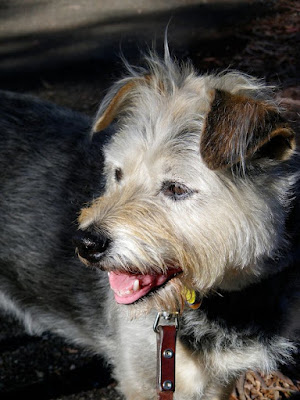
I used to write a blog titled "Rambles with Holly". It, among other things, was about the walking and hiking that I did with my dog, Holly.  My original plan was to call it "Travels with Holly" as an homage to Steinbeck, but that name was already taken at the time. As it turns out, we did a lot more walking locally than traveling, so it was probably for the best. The blog went on hiatus in 2014 after Holly crossed over the Rainbow Bridge.

However, a cartoon I came across the other day brought back memories of the good times that she and I had together. 


Holly and Me: photo by Cliff Hutson


I am taking the liberty of publishing it here.

Two Treats and a Flask of Bourbon


Bliss Cartoon
Bliss Cartoon


The bourbon was mine


Classic Stanley Flask: photo by Cliff Hutson


Plenty of water and treats, for both of us, were a regular thing. I seldom packed this flask, but I kept it handy in case the occasion should ever arise. 


Aged Bourbon: photo by Cliff Hutson

I like to think that I kept my bar adequately stocked as well.


On the Trail


A Happy Dog: photo by Cliff Hutson

Fair weather or foul, Holly was in her element when she was on the trail. A life outdoors is a life well lived.


Monday, November 30, 2020

Dodder

California Dodder

One of the sites I referred to when preparing to write about a plant I encountered in my rambles is maintained by the Consortium of California Herbaria  which provides information about California vascular plant specimens that are housed in participant herbaria. One can search on just about any plant and obtain a list of accessions from around the state.

California Dodder (Cuscuta californica), hits close to home as it has records dating from 1897 to 2009 for specimens found in and around Claremont. One was collected from the Bernard Field Station. The other was found along Thompson Creek, where Holly and I often passed by the plant on our walks.

California Dodder: photo by Cliff Hutson

Cuscuta californica, also called Chaparral Dodder, is an annual parasitic herb or vine that is native to California. It is also found outside of California, but is confined to western North America. Dodder is readily identified by its threadlike, hairless, yellow, orange, or red shoots which twine around host plants eventually creating a tangled mat. One notable feature is that it does not usually have roots that reach the ground. Instead, knoblike organs along the shoot (haustoria) penetrate the host stem. Shoots either lack leaves or have very tiny red, yellow, or orange scalelike leaves pressed close to the stem. It tends to bloom from May through October. The white flowers are tiny, only about 3 to 6 millimeters wide. The fruits are even smaller.

Dodder once had its own family, but it is now consigned to CONVOLVULACEAE, the Morning Glory Family. The epithet Cuscuta seemingly comes from Cuscu'ta a name of Arabic derivation meaning "dodder”. The common name, Chaparral Dodder, tips us to one of its habitats. It is also found through out the state in many other plant communities such as forests and grasslands. And, of course, “the City of Trees and PhDs”.

Wednesday, December 26, 2018

Looking Backwards

From the Heath: photo by Cliff Hutson


The end of the year is an excellent time for most of us to take stock of the things we have done over the past twelve months. One can look back and ask some hard questions. Did you grow and learn important truths about life, and who you are? Did you take meaningful steps toward accomplishing your hopes and dreams?

One of my aspirations for 2018 was to post to this blog every other Wednesday, and, with this entry, have achieved it.

'Why do such a thing?', the astute reader may very well ask. It could be said that this blog is, in a sense, my gift to you the reader. It is a gift of my talent and my dedication. But, the truth is that i do it to amuse myself, and to keep my mind occupied.

I began this endeavor in 2007. The early years were quite spotty. And, during 2010 - 2014 most of my writing was devoted to "Rambles with Holly"; probably the stronger of these efforts.  As I write this, I see that the page views for the all time history of "Pictures and Words" are only 25,732. Not a heck of a lot, and there is only one follower. Still, it has been fun.

Many musings of this sort include a "top list" of some sort. I am going to do five. This might make an interesting Venn diagram as there is a strong correlation between what I feel was some of my best writing garnered some of the most views.

The Top 5 of 2018:


“Eating Well”

“Long Haul Dining”

“a·nal·o·gy”

“Reading Log 2017 (Plus Robots)”

“Southern Greens”

They are all about food or books. I wonder what that says about me?

Food Photography: photo by Cliff Hutson

Wednesday, September 19, 2018

Gone Fishin'


Downtime


Gone Fishing: photo by Cliff Hutson

Sometimes a person just needs to take a break. 

“Insight comes, more often than not, from looking at what’s been on the table all along, in front of everybody, rather than from discovering something new.”—David McCullough


Wednesday, September 28, 2016

National Drink Beer Day

Drink Local: photo by Cliff Hutson

It seems that September 28th is National Drink Beer Day here in the US of A,  marking the closing of the Oktoberfest season. Many people apparently will enjoy it by having a glass of their favorite beer at a local tavern; and will use #DrinkBeerDay to post the occasion on social media.

I am truly puzzled that something called Oktoberfest takes place in September. But, it is what it is, any excuse to drink beer is a good excuse to drink beer. Is it not?

My late wife and I first partook of the festivities in the mid-1970s at a place called Alpine Village. It was a lot of fun then. And, a lot more low key that it seems to be today.

Last Name Brewing: photo by Cliff Hutson
These days, I am loathe to travel so far afield. Close to home, I am torn between Last Name Brewing (originally called Dale Brothers) and Claremont Craft Ales.

Claremont Craft Ales: photo by Cliff Hutson

My favorite brew at the former is Runway IPA; at the later it is Jacaranda Rye India Pale Ale.
SaveSave

Wednesday, July 27, 2016

Water

The Ocean

Waves . . . Peace: photo by Cliff Hutson

It has been a long time since I have seen the ocean, I think I should.


The Lake

The Lake: image by Cliff Hutson

"Water is a dependable antidote for nearly anything that is troubling, including regret." - Doc Ford

SaveSave

Wednesday, April 6, 2016

Street Art

One of the simple pleasures in life is to grab a small camera and walk around town to see what art one can see.

Claremont


photo by Cliff Hutson

photo by Cliff Hutson

photo by Cliff Hutson

photo by Cliff Hutson


Pomona


photo by Cliff Hutson

photo by Cliff Hutson

photo by Cliff Hutson

Wednesday, March 23, 2016

Bird’s Eye Gilia

Tricolor Gilia


Bird's Eye Gilia: photo by Cliff Hutson


Bird’s Eye Gilia, or Tricolor Gilia, (Gilia tricolor) is an annual herb that is native to California, where it is found naturally in the Central Valley and surrounding mountain ranges and foothills, with major populations around the Bay Area. 

A member of the Phlox family (Polemoniaceae), it is described as delicate with a spreading branched stem that grows up to a foot in height. The leaves are alternate and finely dissected. It may bloom from April through August. One would think, given the name, that the, 1/2 inch wide or wider flowers, borne atop the stems, would have three colors. White and lavender are predominate in the petals. One then has a choice of the blue pollen or one of the throat colors of yellow and dark purple for the third. One source cites the “blue stamens encircling the yellow throat of the flower, which is set off by a dark purple ring”.  The flowers seem very attractive to bees. Humans can only imagine what they are seeing at their short-wavelength end of the spectrum of visible light.

The Gilia genus, as previously noted, is named for Filippo Luigi Gilii (1756-1821), naturalist and director of the Vatican observatory.  He, for twenty-one years, made twice daily meteorological readings at the Observatory, and had the meridian line and obelisk placed in front of St. Peter's for readings of the seasons.

This gilia is widely cultivated, being frequently included in wildflower seed mixes. In addition to bees, it attracts butterflies and birds. It is drought-tolerant; suitable for xeriscaping, and does not mind full sun. My research found  herbaria with two specimens that were collected well outside its range.  One was from Silverado Canyon in Orange County. The other from “Claremont; North side of Foothill Blvd. between Darthmouth (sic) and College Ave.” As the latter is just out side the grounds of the botanic garden where I work, I am willing to bet that these specimens were garden escapees. 


Wednesday, February 17, 2016

Ninebark

Pacific NInebark

Pacific NInebark or Western Ninebark (Physocarpus capitatus) is a shrub, in the family Rosaceae, that is native to California and confined to western North America - from southern Alaska east to Montana and Utah, and south to southern California; in the Redwood Forest, Chaparral, Yellow Pine Forest, Red Fir Forest, wetland-riparian communities.


Pacific Ninebark: photo by Cliff Hutson

The plant gets its common name from its bark which may peel showing several layers. The name Physocarpus is from the Greek phusa or physa, "bladder" and karpos, "fruit," thus "bladdery fruit”.  The appellation capitatus refers to the way the flowers form in a head-like cluster.

It is a deciduous bush with round clusters of white flowers, with five petals and numerous red-tipped stamens, in 3"-5" clusters, flowering May through July. The blossoms have been noted as being attractive  to a large number of native bees. Small animals and birds find shelter in its branches. The leaves are alternate, generally serrate, and remind me of small grape or currant leaves, though some say they are maple-like. They are lobed about 1.2–5.5 inches long and broad, which turn intense red to orange in the fall. It can grow to eight feet tall. The fruit is an inflated glossy red pod which turns dry and brown and then splits open to release seeds.

Many nurseries recommend the plant not only for its delightful display of flowers, and its showiness in Fall, but also for the sculptural attractiveness the rest of the year. While it grows most robustly in wet environments, it is drought-tolerant to a degree and could do well in any garden where the climate is not oppressively hot.

Thursday, December 17, 2015

Great Basin Sagebrush


Artemisia tridentata


Great Basin Sagebrush: photo by Cliff Hutson


Great Basin sagebrush, Artemisia tridentata, is closely associated with the Great Basin Desert which lies east of the Sierra Nevada Mountains.  It additionally occurs in the southern Sierra and Peninsular ranges. The herbarium at Rancho Santa Ana Botanic Garden even contains specimens collected in Los Angeles, Riverside, and San Bernardino counties. Neither is the plant limited to the Sagebrush Scrub community. It can be found in, among others, desert scrub, pinyon-juniper woodland, and Joshua tree woodland.

These habits clearly represent a vast range in climate, soil types, competition with other plants, and animals. One of plant’s features that makes for this adaptability is that it has two sets of roots. Shallow roots that lie just below the surface of the soil collect any precipitation that falls. A very strong central root may go as deep as thirteen feet, frequently tapping in to the water table. 

Artemisia tridentata: photo by Cliff Hutson

Also known as Big Sagebrush, it is an evergreen shrub, although one of my sources described it as “evergray” due to the lovely gray-green color of its leaves. The hairy leaves are, as described in Jepson eFlora, “Generally wedge-shaped, generally (0)3(5)-toothed or lobed at tip”. Aye, there's the rub. The appellation “tridentata” means three-toothed, but on some plants the leaves have no teeth at all. Some may have little lobes that are more bumps than teeth. Another may have teeth that are fang-like in appearance. Keep in mind, too, that sagebrush is not sage, even though it can have a similar tangy fragrance. 

The many-branched shrub grows from a couple of feet in height to six feet tall, and about as wide. Small, or insignificant, yellow flowers in long, loosely arranged tubular clusters pop out in late summer or early fall. The production of edible seeds completes the cycle. 

Thursday, December 3, 2015

California Juniper

Juniperus californica


 (Juniperus californica)
California Juniper: photo by Cliff Hutson


California Juniper is a shrub-like tree that is native to California and is found only slightly beyond California’s borders; a short distance into the Great Basin in southern Nevada, northwestern Arizona, and Baja California. Throughout our state it is found in the Peninsular Ranges, Transverse Ranges, California Coast Ranges, Sacramento Valley foothills, Sierra Nevada, and at higher elevation sky islands in the Mojave Desert ranges in Pinyon-Juniper Woodland, Joshua Tree Woodland, and Foothill Woodland communities. It is a member of the Cupressaceae or cypress family

The plant can grow to forty feet in height, but is usually much shorter (10-15 ft.). The leaves are scalelike, and yellow-green in color.  The bark is ashy gray to brown, and furrowed or shredded in appearance. The “berries” are actually cones (7–12 mm) which are described as bluish (although they look greenish to me), with a bloom, and contain one or two seeds. The cones are red-brown when dry. California juniper is said to be dioecious, producing cones of only one sex on an individual plant. But a small percentage of plants are monoecious, i.e., both sexes on the same plant.

Juniperus californica provides food and shelter for a variety of mammals and birds. Notably, it is a larval host for the native moth Sequoia sphinx (Sphinx sequoiae). It is popular species for bonsai; and also has value as an ornamental being drought-tolerant and requiring no water after it is established.

Indigenous people used the wood for sinew-backed bows. South Coast Province people also ground up the cones and molded them into cakes, which were said to taste sweet. It is reported that other groups ate the berries fresh or prepared them as a mush. A medical decoction was also used to treat rheumatism and urinary problems. 

Monday, November 16, 2015

Where I Have Been

States I Have Visited


visited 11 states (22%)
Create your own visited map of The United States or Brazil travel guide for Android


You can call me limited in scope if you wish, but I have seen most of what I have wanted to in these United States.

There are three places I still hope to get to visit:

Martha's Vineyard - to stop in at The Black Dog;

Seattle, WA - to see the Filson flagship store, and:

Chicago, IL - my late wife loved this city and wanted to take me there, but I never made the time to do it.


Photo by Cliff Hutson - General Grant (tree) - Kings Canyon National Park

General Grant Tree - Kings Canyon National Park


Thursday, January 1, 2015

The Books I Read in 2014

The idea for a monthly photographic record of what books I read was inspired by the work of David Allen, a columnist for my local paper. But, it did not hit me until I was well into February and by then January was lost in the fog of time.  Therefore, this starts with the books I use all year long either on my rambles or as a resource for the "Plant of the Month" article I write for the Rancho Santa Ana Botanic Garden publication Oak Notes.

I also decided, taking a page from Kenton Nelson, not to describe each book. The reader of this blog can decide what to think about me or my choices. 


Reference

February

March

April

May

June

July

August

September

October

November

December

Sunday, October 13, 2013

Introverts on Twitter


He who travels fastest travels alone.