Showing posts with label trees. Show all posts

Monday, June 10, 2024

It's Back!

Jacaranda Season


Jacaranda Blossoms: photo by Cliff Hutson

I took the weekend off to the watch the Memorial Tournament. So, I am linking to a timely rerun; the Jacarandas are once again in bloom this year.


Jacaranda IPA: photo by Cliff Hutson


Update (06/15/2024):


I seldom return to something I have posted, but I saw this today and could not resist proving that I am not the only who thinks that these trees are special.


Monday, June 26, 2023

A Record of My Living

 June 26 - Through the Years:


I write this blog for my own  amusement. Which is fine as sometimes it seems that I am the only one who reads it. Even so, some weeks it is difficult to come up with a topic that would be of interest even to me. This was going to be one of those. Then I recalled something I wrote not too far back - "My photography is a record of my living, for anyone who really sees."

So, I decided to see what the record was for the date of June 26, relying on the years I was working on Photo a Day (PaD) projects. 

2005

Toy Loan: photo by Cliff Hutson


My wife and I had a house full of pets in 2005. One afternoon, Buster (a Samoyed), for reasons known only to himself, walked over and dropped his bear so Pumpkin could nap with it. The cat, having already appreciated the Orvis dog bed, did not do anything to show his appreciation for the loan of the toy.

2006

World Cup: photo by Cliff Hutson

It seems that I was watching as much of the FIFA 2006 World Cup as I could.

2009

Korean Omelet: photo by Cliff Hutson


There was a sandwich place called "The Tummy Stuffer" within walking distance of where I was headquartered in 2009. The posted menu featured 26 sandwiches (counting burritos). However, there was also a secret menu and one afternoon the owner said I could try this omelet. It was delicious. 

2010

Pepper Tree Litter: photo by Cliff Hutson


The year 2010 was my first full year of retirement and several days a week my terrier-mix Holly and I would take walks along the Thomson Creek Trail. I usually had a camera with me and would photograph anything that caught my eye. This day it what had fallen to the ground underneath a California pepper tree (Schinus molle). 


Monday, June 27, 2022

Orange Blossom Special

 A Special Day


Orange Blossoms: photo by Cliff Hutson


National Orange Blossom Day is celebrated annually on June 27.  It would seem to go without saying that orange blossoms are the fragrant flower of the orange tree (Citrus sinensis).  These blossoms have been traditionally associated with good fortune and long been popular in bridal bouquets and head wreaths. But, there are others.

Fresh bitter orange (Citrus aurantium)  blossoms are often distilled for their essential oils to make perfume. However, the process also creates a by-product widely used in Middle Eastern, North African, and European cooking: orange blossom water, or orange flower water. The water is pleasantly bitter, like orange peel, but intensely aromatic, and it is thus often used sparingly. While occasionally used in savory dishes, it's more frequently used in sweets such as baklava, the Lebanese rice pudding riz bi haleeb, Moroccan ktefa, and French madeleines and gibassier. The flowers are also used to brew tea.

Finally, I can't read about orange blossoms without thinking of Johnny Cash.


Monday, May 16, 2022

Love a Tree Day

 National Love a Tree Day


Trees: photo by Cliff Hutson


National Love A Tree Day comes on May 16th, right in the middle of Garden for Wildlife Month, That makes sense as trees not only provide food and shelter for birds and other animals. 


As a matter of fact, trees are some of the most important plants on the planet and humanity’s very existence depends on their continued well-being. They provide us with lumber, nuts, fruit, shade, and shelter. In addition, they produce oxygen for us to breathe and help to absorb excess carbon dioxide from the atmosphere. So, we should give them the attention that they deserve, today and everyday.

Giant Sequoias: photo by Cliff Hutson

By the way, trees are not a taxonomic group but include a variety of plant species that have independently evolved a trunk and branches seemingly as a way to stand above other plants to compete for sunlight. 


Monday, April 25, 2022

Oak Woodland

 Oak Woodland


Oak Trees: photo by Cliff Hutson


When I picture an oak woodland in my mind it is one with coast live oaks that stand closely together so that their canopies overlap. Low bushes cover the ground along with a layer of debris.

Coast live oak (Quercus agrifolia) is the most abundant species of oak along the California coast, ranging from Sonoma County into Baja California. Of course, in other parts of the state different oaks will predominate; but coast live oak is the one I grew up  and continue to see almost daily.

It is well adapted to to our Mediterranean climate of hot, dry summers and cool, hopefully rainy winters. Coast live oaks are evergreen, with a tough little leaf. 


Leaf and Acorn (Quercus agrifolia): photo by Cliff Huston


The oak woodland is one of my favorite habitats. More than coincidently, I guess, in it are found some of my favorite animals as well: Acorn Woodpecker, Western Scrub Jay, and Western Gray Squirrel to recite just three. Plants in this habit could include California Bay and Toyon.


California Bay: photo by Cliff Hutson


I have read that many early settlers wrote about the mystical beauty of oak trees. I certainly get an inspirational feeling when ever I get the opportunity to spend some quiet moments of reflection in a such a grove.


Coast Live Oak: photo by Cliff Hutson


Monday, November 29, 2021

Nature Notes: Coast Live Oak

 Coast Live Oak


Coast Live Oak: photo by Cliff Hutson


The coast live oak (Quercus agrifolia) derives its name for the reason that, as an evergreen, it does not shed its leaves for a dormant season. It is is native to California, occurring in our Mediterranean habitats which are characterized by mild, wet winters and hot, dry summers. and is the most abundant species of oak along the coast, ranging from Sonoma County into Baja California. 

It is notable that the coast live oak, especially in its Spanish forms encino or encina, encinitas "little oaks", and encinal "oak grove", gave its name to seven land grants across California and to many communities and geographic features. These include Rancho Los Encinos, the Los Angeles community of Encino, Encinitas near San Diego, and Encinal del Temescal, now the city of Oakland.


Sunday, April 19, 2020

California Native Plant Week #9

A 9 Day Week


"Eight days a week
Is not enough to show I care"

- The Beatles

An eight day week was not enough for The Beatles, and apparently not for California Native Plant Week as well. So, here we are with my last plant for this year.

x Chiranthofremontia lenzii


x Chiranthofremontia lenzii: photo by Cliff Hutson

X Chiranthofremontia lenzii (hybrid monkey hand tree) is a large bush that is a hybrid between Mexico's Chiranthodendron pentadactylon and California's Fremontia californicum. It has a glorious yellow/orange blooms. The distinctive flowers appear in late spring and early summer; the stamens are long, curve upward, and give the distinct impression of a clawed hand or paw.

The nothogeneric name is derived from the two generic names using "Chir- antho" (hand, anther) and "Fremont" portions of the parental generic names. The species epithet honors Dr. Lee Wayne Lenz, Director Emeritus of Rancho Santa Ana Botanic Garden, who made many native hybrids, including Fremontodendron 'California Glory,' 'Pacific Sunset,' and 'San Gabriel'.


Hybrid Monkey Hand Tree: photo by Cliff Hutson


Earth Day Again


I was in grad school when the very first Earth Day happened.  The campus was alive with the sound of music and many well attended events. Obviously, this year's 50th anniversary observance has to be very different. The Union of Concerned Scientists has planned a three-day event called Earth Day Live.

What Is Earth Day Live? Find out here.


Thursday, April 16, 2020

California Native Plant Week #6

Joshua Tree


Joshua Tree Forest: photo by Cliff Hutson

While I am hesitant to once again write about a plant and perhaps draw too much attention to one of our over-pressured national parks, this tree is one of California's most iconic species.  

The park is named for the Joshua trees (Yucca brevifolia) native to the Mojave Desert, but it does occur outside those boundaries. And, sadly, some say that in the not too distant future it may no longer grow there.  

California Native Plant Week Takes a Different Turn This Year


A thoughtful essay from CNPS:  Native plants can offer hope, fun, and healthy distraction during stay-at-home orders.

Another way to connect with nature:  Birds


"Millions of people who aren’t frontline workers in the COVID-19 pandemic are adjusting to a new routine that means staying home — or close to it. Many are seeking solace outside."


But, wait, there's more!


There are plenty of other fun activities easy to enjoy while maintaining safe social distancing.

Wednesday, June 26, 2019

My Favorite Season

Blue Jacaranda Blossoms: photo by Cliff Hutson


“Beautiful hands are as rare as jacaranda trees in bloom, 
in a city where pretty faces are as common as runs in dollar stockings.”
 - Raymond Chandler


Jacaranda Trees


It can be very difficult to discern seasons in Southern California. Temperatures can near triple digits in December as easily as they can in July. June days can be as cool as the ones in January. But, one “season” that is hard to miss is “Jacaranda season”. One of my favorite times of the year, due to its beauty of blue-violet flowered trees which line our streets and fill many public spaces - such as Pomona's Civic Center Plaza.

Jacaranda mimosifolia, also known as the “blue jacaranda,” usually blooms in late May or early June, and the blossoms last for a few weeks. The trumpet-shaped flowers are an inch or two long, and usually five-petaled. They look good on the trees. I also think that they look great as a carpet on the ground. But, many complain of the litter gumming up the soles of their shoes. I will admit that the sticky flowers can also be tough on a car’s finish. Gardening guides recommend that these trees be planted well away from swimming pools or other high-maintenance areas.

Jacarandas, ubiquitous as they are, are not native to California. The trees are indigenous to Northwestern Argentina and adjacent Bolivia into Brazil. Mature trees can reach 25 to 45 feet, in an oval canopy spread almost as wide as its height, with light green, fernlike, 10-12" long compound leaves with small oval leaflets.

Trivia lovers might be interested to know that a Jacaranda mimosifolia in Santa Ana is registered as a California Big Tree. It measures 58 feet high, with a trunk circumference of 98 inches and a crown spread of 73 feet. But, as I said, I think they look great in any size.


Pomona City Hall: photo by Cliff Hutson

Wednesday, September 5, 2018

Wednesday, February 8, 2017

January 2017 Reading

“It is what you read when you don't have to that determines what you will be when you can't help it.” 
– Oscar Wilde

The Books I Finished Reading in January 2017


January 2017 Reading: photo by Cliff Hutson

Recently, I came across an article that maintains that the books we read reflect how healthy, mentally stable, and secure we are at the time in life in which we read them. I am not sure that I totally buy in to that. But, it is an interesting proposition; and, it introduced me to the wonderful quote at the top of this post.

It can be said, with little doubt, that I don't have to read anything at this point in my life. Yet, I find it hard to imagine life without reading. (And, it is supposed to be good for me.)  I read both for information and pleasure. Two of the four books I read in January fall in to each category.

The first includes “Secrets of the Oak Woodland” by Kate Marianchild. It came highly recommend by by a couple of my fellow Nature Interpreters at the Rancho Santa Ana Botanic Garden. I found the information to be quite helpful. But, based on personal experience, feel that some of should be taken with a grain of salt.

I can not recall how I came across "Sage Living" by Anne Sage. I read books of this nature both to study how other photographers approach these projects; as well as getting design ideas for my house. This book was a bit disappointing. But that may just be due to the mood I was in at the time I picked it up; so I plan to reread it in the not too distant future. My main complaint is that the text and the images seem to have a certain disconnect. However, I already think that it was well worth the purchase price - the photograph on page 185 validates a vision I had previously conceived of an Eames chair and Pendleton blanket in my own home.

The books in the second group both come under the genre of mystery. I thought that I had read all the books in the Spenser series written by Robert B. Parker, prior to his death.  (Yes, I know, the concept of of an author writing a book after their demise seems strange. But, somehow the publishers of Parker, Clive Cussler, and others have managed to circumvent the obvious difficultly in this endeavor.  I don't envision myself ever reading any of those tomes.) However, somehow I had managed to miss "Potshot" so when Amazon.com brought it to my attention, I jumped at it. I think it is a pretty good story. An added enjoyment for me is that I am fairly certain that I know the town in Arizona that the community of Potshot is based upon.

The final book of the month was a Jack Reacher novel, the twenty-first I think, from Lee Child. Long story short, "Night School" is a good read, but not one of his best.

What have you read of late?


SaveSaveSaveSaveSaveSaveSaveSave

Wednesday, November 23, 2016

National Cashew Day

Who knew?


Cashews: photo by Cliff Hutson

National Cashew Day is celebrated annually on November 23. This day was first observed in 2015; so I am not embarrassed about not finding out about it until yesterday.

But, I have enjoyed eating them for years. Not only are these so-called nuts tasty, they are healthy. Cashews contain copper, magnesium, manganese, phosphorus, and vitamin K, along with lesser-known phytonutrients, such as antioxidants, tyrosinase, melanin, elastin, proanthocyanidins, and oleic acid, provide hard-to-ignore benefits for the body. The seed, or drupe, can be eaten on its own, used in various cuisines, or processed into cashew cheese or cashew butter. 

I am not a doctor, nor do I portray one on TV, but I have read that one can lower their risk of cardiovascular and coronary heart disease by eating a serving of cashews or a tablespoon of cashew butter, a few times a week.


SaveSaveSaveSaveSaveSave
SaveSave

Wednesday, November 16, 2016

Palo Verde

What's in a name?


Palo Verde: photo by Cliff Hutson
One of the things that intrigues me about leading tours at RSABG is the feed back I receive from guests. One plant that leads to many discussions is a tree we call Palo Verde. Everyone agrees that “verde” is Spanish for “green”. However, “palo” is variously translated as “stick”, “pole”, or “wood”. The “green” in its name comes from the color of the trunk and limbs which contain chlorophyll. This feature allows the tree to photosynthesize when it drops its leaves due to drought conditions, and again in winter.

Native to California, various specious of Palo Verde also occur throughout the Southwest and part of Mexico. They are found predominantly in desert washes, and occasionally in creosote desert scrub habitat, accessing seeps in desert hills up to 3,600 feet .

The most common species are: Little-leaved or Yellow Palo Verde (Parkinsonia aculeata) has a yellow-green trunk, tiny leaves, and a spine at the end of each branch. Their seeds are large with a seed pod that constricts around them; and Blue Palo Verde (Parkinsonia florida)  which has a blue-green trunk, larger leaves, small spines along the branch at the leaf nodes, and no spine at the end of the branch. Blue Palo Verde seed pods are larger than little-leaved seed pods, and the pod does not constrict around the seeds.

Palo Verde Blossoms: photo by Cliff Hutson
The yellow pea-like flowers bloom in spring and frequently occur intermittently through out the year. Both the literature and my personal observation indicate that the plant seems to attract the most bees and the most species of bees than any other tree. This factor, the sheer beauty of its filigreed leaves, and its low water requirement have made Palo Verde a popular landscape tree In our area.

Bee on Palo Verde: photo by Cliff Hutson


Wednesday, August 17, 2016

Holly in California?

Comarostaphylis diversifolia
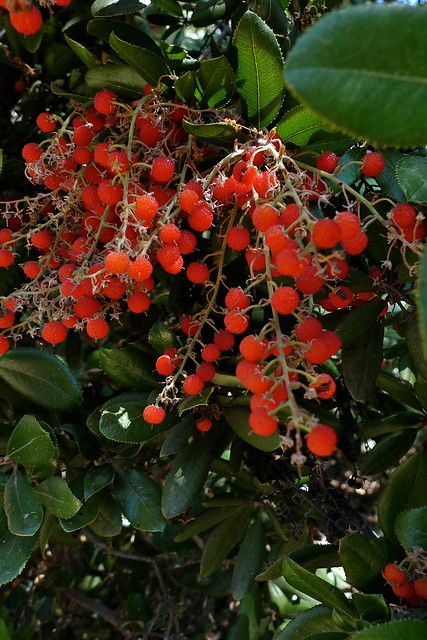
Summer Holly: photo by Cliff Hutson

Plants of the genus Ilex (Holly) are not native to California, though some may have naturalized. However, several of our native plants do have "holly" as part of their common names. This is no doubt due to their having pointy leaves and red berries, but in total disregard to their taxonomy. 

Summer holly (Comarostaphylis diversifolia) is found in coastal chaparral from Santa Barbara County southerly into Baja California. There may be populations on the Channel Islands as well. Some sources cite that the geography makes for two subspecies: Comarostaphylis diversifolia ssp. diversifolia in coastal Southern California and Baja; and Comarostaphylis diversifolia ssp. planifolia on the Channel Islands and the Transverse Ranges north of Los Angeles. It is not very common, but not yet listed as rare.

A slow‐growing, evergreen shrub or tree to 20 ft. tall. Attractive features include shiny leaves, white flowers, red berries and shredded bark. While the flowers are urn-shaped similar to the more familiar manzanita, the red berries are warty or wrinkly rather than smooth. That feature also distinguishes it from toyon. Summer holly is a member of Ericaceae, commonly known as the heath or heather family, a family of flowering plants found most commonly in acid and infertile growing conditions.

Summer Holly can be used in the home landscape. It does well in dry part shade and does not tolerate direct water in the summer. Some care must be taken, but one pay off is that birds are attracted to the fruit.
SaveSaveSaveSave

Wednesday, July 20, 2016

Bottle House

Bottle House: photo by Cliff Hutson

One of my recent acquisitions is a set of bottle stoppers which look like tiny wooden houses. The "Bottle House" is made from beech wood and rubber; and designed by  Daphna Laurens for Areaware.

I find that they work as good as could be expected. The Bottle House certainly looks better than any alternative that I have ever come across.


SaveSave

Wednesday, July 13, 2016

To See, or Not to See

Deer on Creek: photo by Cliff Hutson

An Artificial Obvious


One of the most asked questions along the Thompson Creek Trail is - “did you see the the deer?” To which, alas, I usually have to answer “no”.

I have seen quite a few deer in my lifetime. When I was in high school I spent a lot of time running through the hills and dales of Griffith Park in the City of Los Angeles and saw them all the time, usually on the golf courses. It is kind of difficult to miss a good sized herd of large animals on a closely trimmed fairway. And, I did manage to see this one along the creek in the above photograph.

Seeing them in the mountains is another story. This was painfully brought to my attention about forty years ago when a young woman of my acquaintance invited me to spend a weekend at her family’s cabin in Mineral King. One evening the two of us and another couple sat on the east-facing porch to watch the setting sun illuminate the west-facing slope across from us. The other three began seeing what must have amounted to dozens of deer. I never saw a one, much to my embarrassment.

Stewart Edward White tells in The Mountains that deer can be invisible to the untrained eye even when they are standing in plain sight. Seemingly, many people, like me, can look straight at them and not see them at all. White discusses what he calls creating “an artificial obvious” as the key to seeing deer.

I first came upon the phrase while reading Annie Dillard’s A Pilgrim at Tinker’s Creek. She did not shed much light on it as far as was concerned. But, now that i have gone to the source, I now understand that in a way we all view the natural world through a filter of sorts. This is to say that in any given situation we tend to see what we want to see and disregard the rest. Thus as I walk along the creek I first pay attention to the light as a photographer. Secondly I tend to notice plants, flowers, and birds based on my work at the botanic garden. Therefore, my eye tends to skip over the brown or gray splotches that would be deer. White, on the other hand, as a hunter will pass his eye over a slope and miss the flowering bush but see the buck which was hidden to me.

Mule Deer: photo by Cliff Hutson

Holly, the dog I hiked with for many years, constructed her own artificial obvious as well. Hers appeared to be based on size. A lizard of say two to three inches was of no importance. A larger one was worthy of investigation. Her interest ranged through birds such as towhees, squirrels, rabbits, cats, and other dogs. She could spot a cottontail the same distance from us as the deer in the above photo and become excited. Yet, she would exhibit no indication that a deer was there at all. Perhaps she felt that at her size large mammals were best ignored. If you pretended they were not there, they might not see you and just go away. Small reptiles and insects must have been beneath her dignity. It occurs to that the little random bred's make-up is primarily terrier. Terriers were bred to pursue vermin such as rats and foxes. These certainly fall within the size of animals that attracted her attention. So, Holly's artificial obvious could have been genetic.

Do we all live in a world of our own making?
SaveSaveSaveSaveSaveSaveSaveSave

Wednesday, June 15, 2016

Jacaranda Season

Blue Jacaranda Blossoms: photo by Cliff Hutson


“Beautiful hands are as rare as jacaranda trees in bloom, 
in a city where pretty faces are as common as runs in dollar stockings.”
 - Raymond Chandler


Jacaranda Trees


It can be very difficult to discern seasons in Southern California. Temperatures can near triple digits in December as easily as they can in July. June days can be as cool as the ones in January. But, one “season” that is hard to miss is “Jacaranda season”. One of my favorite times of the year, due to its beauty of blue-violet flowered trees which line our streets and fill many public spaces.

Jacaranda mimosifolia, also known as the “blue jacaranda,” usually blooms in late May or early June, and the blossoms last for a few weeks. The trumpet-shaped flowers are an inch or two long, and usually five-petaled. They look good on the trees. I also think that they look great as a carpet on the ground. But, many complain of the litter gumming up the soles of their shoes. I will admit that the sticky flowers can also be tough on a car’s finish. Gardening guides recommend that these trees be planted well away from swimming pools or other high-maintenance areas.

Jacarandas, ubiquitous as they are, are not native to our area. The trees are indigenous to Northwestern Argentina and adjacent Bolivia into Brazil. Mature trees can reach 25 to 45 feet, in an oval canopy spread almost as wide as its height, with light green, fernlike, 10-12" long compound leaves with small oval leaflets.

Trivia lovers might be interested to know that a Jacaranda mimosifolia in Santa Ana is registered as a California Big Tree. It measures 58 feet high, with a trunk circumference of 98 inches and a crown spread of 73 feet. But, as I said, I think they look great in any size.


SaveSaveSaveSave