Showing posts with label manzanita. Show all posts
Monday, June 23, 2025
Tuesday, June 23, 2020
National Pollinator Week 2020
The birds and the invertebrates
![]() |
| Ant: photo by Cliff Hutson |
June 22-28, 2020 is National Pollinator Week. It is an annual celebration of the many animals that move pollen to help plants make fruit or seeds.
While it is probably safe to say that most people readily identify honey bees as pollinators, many other creatures are also crucial to the lifecycle of plants. It should not be a surprise that butterflies and moths are among the usual suspects. (Ants should probably be excluded, but I like my opening photograph so I am including it anyway.)
![]() |
| Butterfly Bush: photo by Cliff Hutson |
Another thing that I find amusing is that much of the literature maintains that flower shape dictates the pollinators for a plant. Which is to say that flat flowers attract butterflies, cup shaped flowers bees, and tubular flowers humming birds. However, as I used to joke with my students, the animals do not read those papers.
To wit, I can present bees that are thinking outside of the box or perhaps they just have a rebellious nature.
![]() |
| Bee on California Sunflower; photo by Cliff Hutson |
![]() |
| Bee & Camellia: photo by Cliff Hutson |
![]() |
| Nevada Mining Bee: photo by Cliff Hutson |
While Ladybugs are noted for eating aphids and other plant destroying pests, it seems that help in pollination as well.
![]() |
| Ladybug: photo by Cliff Hutson |
Finally, this butterfly seems to be going by the book.
![]() |
| Painted Lady Butterfly: photo by Cliff Hutson |
Pollinators are essential to our environment. The ecological service they provide is necessary for the reproduction of over 85% of the world’s flowering plants, including more than two-thirds of the world’s crop species.
Here are some ways that we can help them to carry on:
- Grow a variety of bee-friendly flowers that bloom from spring through fall.
- Protect and provide bee nests and caterpillar host plants.
- Avoid using pesticides, especially insecticides.
Wednesday, August 17, 2016
Holly in California?
![]() |
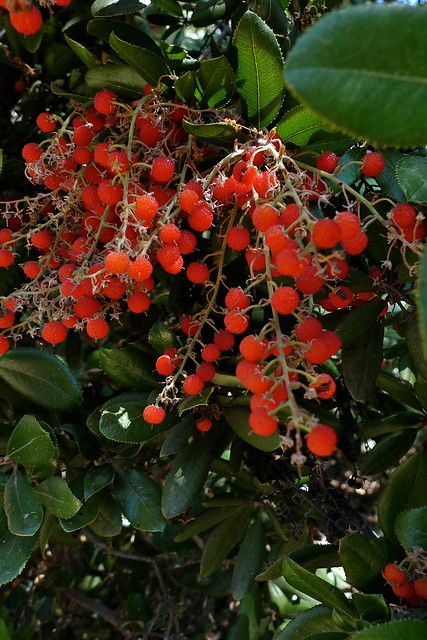
| Summer Holly: photo by Cliff Hutson |
Plants of the genus Ilex (Holly) are not native to California, though some may have naturalized. However, several of our native plants do have "holly" as part of their common names. This is no doubt due to their having pointy leaves and red berries, but in total disregard to their taxonomy.
Summer holly (Comarostaphylis diversifolia) is found in coastal chaparral from Santa Barbara County southerly into Baja California. There may be populations on the Channel Islands as well. Some sources cite that the geography makes for two subspecies: Comarostaphylis diversifolia ssp. diversifolia in coastal Southern California and Baja; and Comarostaphylis diversifolia ssp. planifolia on the Channel Islands and the Transverse Ranges north of Los Angeles. It is not very common, but not yet listed as rare.
A slow‐growing, evergreen shrub or tree to 20 ft. tall. Attractive features include shiny leaves, white flowers, red berries and shredded bark. While the flowers are urn-shaped similar to the more familiar manzanita, the red berries are warty or wrinkly rather than smooth. That feature also distinguishes it from toyon. Summer holly is a member of Ericaceae, commonly known as the heath or heather family, a family of flowering plants found most commonly in acid and infertile growing conditions.
Summer Holly can be used in the home landscape. It does well in dry part shade and does not tolerate direct water in the summer. Some care must be taken, but one pay off is that birds are attracted to the fruit.
SaveSaveSaveSave
Summer Holly can be used in the home landscape. It does well in dry part shade and does not tolerate direct water in the summer. Some care must be taken, but one pay off is that birds are attracted to the fruit.
Labels:
Baja,
birds,
botany,
California,
cliff hutson,
flower,
foliage,
gardening,
Holly,
manzanita,
native plants,
natural history,
shrub,
toyon,
trees,
wildflowers
Subscribe to:
Posts (Atom)