Showing posts with label Rancho Santa Ana Botanic Garden. Show all posts

Wednesday, April 17, 2019

Wildflower Week

RSABG Badge: photo by Cliff Hutson

Wildflower Week


This past weekend kicked off Wildflower Week at the the botanic garden where I work. This prompted me to muse about one of my personal favorites.

Hooker’s Evening Primrose


Oenothera elata hookeri: photo by Cliff Hutson

Hooker’s evening primrose, Oenothera elata hookeri, is a member of a genus of about 145 species of herbaceous flowering plants native to the Americas. It is the type genus of the family Onagraceae. Common names include evening primrose, suncups, and sundrops.

The appellation “evening” comes from the habit of the blooms of many species opening in twilight. An interesting aspect of evening primroses is that their flowers open very quickly, some in under a minute. This occurs because the cells at the margins of the sepals are connected in a zipper-like structure. As the petals grow, they break through the zipper and quickly spill out.

The hookeri subspecies is native to California and also grows in much of western and central North America. It is tall for an evening primrose, reaching heights of up to six feet. It flowers from June through September with yellow blossoms that are 2 to 3 inches wide. One of the most distinctive features of the flower is the stigma, which has four branches in an X shape.

Calflora says that this plant generally inhabits moist places in coastal or somewhat inland areas at lower elevations. Other sources state that it can be found on open slopes, road banks, and grassy areas from the plains to the mountains. One nursery, which carries it, maintains that it will survive drought and flooding, sun, wind and cold.

The common name always seemed a bit risqué to me. But, it is actually named for Sir William Jackson Hooker (1785-1865), professor of botany and director of the Royal Botanical Gardens at Kew in the mid 19th century and author of several botanical works. Among his friends and colleagues were David Douglas, Thomas Nuttall, and Asa Gray, after whom he named the genus Grayia. How is that for name dropping?


Wednesday, April 19, 2017

Nature vs the Folly of Man

“History shows again and again how nature points up the folly of man . . .”
Blue Oyster Cult, "Godzilla" 

Monarch Caterpillar: photo by Cliff Hutson

A Book


Last night I finished reading "Career of Evil," by Robert Galbraith. This author is better known as J.K. Rowling, of Harry Potter fame. It is the third book, written under this pseudonym,  about Cormoran Strike, a private deceive, and by far the worst in my opinion. I very much enjoyed "Cuckoo's Calling", the first in the series. The second "The Silkworm" was just adequate, to my mind. This last book stinks, in my opinion.

A more discerning reader might take exception to that. Which is cool by me. But, I found the descriptions of the crimes to be far too grisly for my taste. I feel that detective stories can be well done without this nonsense as proven by Robert Crais, Agatha Christy, and Edgar Allen Poe, whom many contend to be the progenitor of the genre.

However, I was very much intrigued that "Career of Evil" has an interesting conceit of heading up most chapters with lyrics from songs recorded by the band Blue Oyster Cult. Now, I have long considered myself to be a BÖC fan, but was not familiar with hardly any of these lyrics. And, after having seen them in this context, may never be able to enjoy listening to the band again.
  
Milkweed in Bloom: photo by Cliff Hutson

The Music


Even so, I will hold on to my second favorite BOC song, "(Don't Fear) The Reaper".  And, the one I like the best, "Godzilla". 

Just like the the novel, I started off this post with a snippet of actual lyrics. However, I have always thought of them as, "nature must pay for the folly of man." 

I, for the purposes of today's lesson, relate this conjecture to the decline of the Monarch Butterfly. As the referenced article states - "Across North America, the number of monarchs has dropped 27 percent in the last year alone, and by four-fifths since the 1990s. Habitat loss, especially in midwestern farm country, is a big reason. Farmers have plowed up most of the nation's milkweed patches to plant GMO soy and corn, much of it for ethanol fuels. But monarch caterpillars can only eat milkweed. And less food means fewer butterflies."


Asclepius fascicularis: photo by Cliff Hutson

The Pitch


Monarch caterpillars rely on milkweeds for food.  Fortunately, many California native species are quite attractive in the garden — and unlike milkweeds from elsewhere, they've evolved to bloom right when California monarchs need them.

Thus, I propose that many of us are in a position to give these little guys a hand. Please consider giving some space to help out our fellow creatures.

An Aside


The California Wildflower Show runs at RSABG from April 22 - 24, and the Butterfly Pavilion opens May 13, 2017.


SaveSaveSaveSaveSaveSaveSaveSaveSaveSaveSaveSaveSaveSaveSaveSave

Wednesday, March 8, 2017

February 2017 Reading

The books I finished reading in the month of February 2017

February 2107 Reading: photo by Cliff Hutson
The month of February was a very slow month for me when it came to reading, only three books. And, fairly thin ones at that. The fault lies within myself as I became addicted to watching "Miss Fisher's Murder Mysteries" on Netflix. Viewing all three seasons took up much of my time.

Perhaps the most interesting of the books was "Island of the Blue Dolphins," by Scott O’Dell. It is a children's novel, and, indeed, it was recommended to me by students from Sycamore Elementary School when I was leading a Native Partners program at the botanic garden. The book had come up from time to time in previous years, but these kids were very insistent once I admitted to not having read it. (I have a good excuse though. When I was in forth grade, it had not yet been written.) Presumptively based on a true story, it tells the story of a young California Indian girl stranded alone for years on one of the Channel Islands. While quite entertaining, I feel that much of it has to be taken with the proverbial grain of salt. However, I am glad that I read it as it may help me put some of the concepts we teach in to a better context for children who have also read it.

Frankly speaking, “Breaking Cat News,” by Georgia Dunn is a bit a cheat as I read it last year. But, in need of some good humor, I picked it up again. Anyone who has any appreciation for cats should love reading about cats reporting on the news that matters to cats. I also read the comic on a daily basis.

“How to See: Visual Adventures in a World God Never Made,” by George Nelson disappointed me a bit. Nelson tells us that - "Einstein has been reported as saying that it is not possible to make an observation unless the observer has a theory to bring to bear on what he is looking at." So, I assumed that this book might give one the tools with which "visual literacy" may be enhanced. It did not do that for me. That could be because I am too much a technician (whose skills are primarily verbal) to pick up what was going on. Or, alternatively, perhaps I am an accomplished enough of a photographer that I already have an intuitive grasp on visual reading. Obviously, a book that has held its own for forty years must have some merit. I intend to give it another go in a few months to see if my view of it can be altered.

Another thing that remains to be seen is if March holds less binge watching and more reading for me.

NOTE: March 8 is National Proofreading Day. Did you find any errors in this post?

#NationalProofreadingDay

SaveSaveSaveSaveSaveSave

Wednesday, November 30, 2016

California Dodder


California Dodder: photo by Cliff Hutson
The astute reader of this blog may recall that I am a Nature Interpreter at Rancho Santa Ana Botanic Garden (RSABG) and lead tours for school children and adults. It was also my pleasure to have written the “Plant of the Month” article for “Oak Notes”, an in-house newsletter, for four years.

One of the sites I refer to, among the usual suspects such as Wikipedia and CNPS, when writing about a plant is maintained by the Consortium of California Herbaria  which provides information about California vascular plant specimens that are housed in participant herbaria. One can search on just about any plant and obtain a list of accessions from around the state.


California Dodder (Cuscuta californica), hits close to home as it has records dating from 1897 to 2009 for specimens found in and around Claremont. Two of these are housed in the RSABG herbarium. One was collected from the Bernard Field Station, just to the east. The other was found along Thompson Creek where I often see the plant.

Cuscuta californica, also called Chaparral Dodder, is an annual parasitic herb or vine that is native to California. It is also found outside of California, but is confined to western North America. Dodder is readily identified by its threadlike, hairless, yellow, orange, or red shoots which twine around host plants eventually creating a tangled mat. One notable feature is that it does not usually have roots that reach the ground. Instead, knoblike organs along the shoot (haustoria) penetrate the host stem. Shoots either lack leaves or have very tiny red, yellow, or orange scalelike leaves pressed close to the stem. It tends to bloom from May through October. The white flowers are tiny, only about 3 to 6 millimeters wide. The fruits are even smaller.

Dodder once had its own family, but it is now consigned to CONVOLVULACEAE, the Morning Glory Family. The epithet Cuscuta seemingly comes from Cuscu'ta a name of Arabic derivation meaning "dodder”. The common name, Chaparral Dodder, tips us to one of its habitats. It is also found through out the state in many other plant communities such as forests and grasslands. And, of course, “the City of Trees and PhDs”.
SaveSaveSaveSaveSaveSaveSaveSaveSaveSave

Wednesday, September 21, 2016

Sunflowers

Coast Sunflower: photo by Cliff Hutson
Coast Sunflower (Encelia californica): photo by Cliff Hutson

The drought in California over the past five some odd years, and the resulting restrictions on watering, have been rough on home gardens, public plantings, and native plants. However, one plant that has been holding its own, at the botanic garden where I work, is one of the sunflowers.

Helianthus annuus 

Helianthus annuus, the common sunflower, is an annual herb that is native to California and is also found elsewhere in North America .  Sunflowers belong to the what is probably the largest family of flowering plants  - the Asteraceae (or Compositae). The name sunflower may derive from the impression that the blooming plant appears to slowly turn its flower towards the sun as the it moves across the sky, or from the shape of the flower which resembles a child’s drawing of the sun.

Sunflowers do display heliotropism in the bud stage. The motion is created by special cells in a flexible segment of the stem just below the bud. However, mature sunflowers become fixed in an easterly direction, with only their leaves continuing to track the sun. This motion, from east to west, is believed to increase photosynthesis.

The term Compositae, i.e., composite, comes from the fact that the “flower”’ is actually composed of many flowers. The flowers on the outer margin are ray flowers. The flowers at the center of the head are the disc flowers, which will mature into seeds. Many sunflowers are beautiful ornamental flowers in an annual bed or a mixed border. They attract bees and are also a good choice for butterfly gardens; monarch butterflies are especially attracted to sunflowers.

“Claremont Sunshine” Sunflower

Claremont Sunshine: photo by Cliff Hutson

RSABG is home to a cultivar of  Helianthus annuus, “Claremont Sunshine”, the plant that is doing pretty well.  Cultivars are bred from exceptional plants of an existing variety because they possess a desired attribute. I read that Bart O’Brien was driving on I-5 and spotted some wild sunflowers that were a very pale yellow, instead of the golden color. So he marked the spot, came back and harvested the seeds, then cultivated them. 

The Fall Planting Festival at Grow Native Nursery will showcase this and thousands of other California native and water efficient plants on October 1, 2016, 10 am - 4:30 pm - Members only, 8 -10 am. 

Rancho Santa Ana Botanic Garden has been selling California native plants since 1978. So, , if you are in Southern California, don’t miss this ideal opportunity to purchase hard-to-find, one-of-a-kind natives and to get your gardening questions answered by friendly, experienced botanic garden professionals and volunteers.

SaveSaveSaveSave
SaveSave

Wednesday, March 23, 2016

Bird’s Eye Gilia

Tricolor Gilia


Bird's Eye Gilia: photo by Cliff Hutson


Bird’s Eye Gilia, or Tricolor Gilia, (Gilia tricolor) is an annual herb that is native to California, where it is found naturally in the Central Valley and surrounding mountain ranges and foothills, with major populations around the Bay Area. 

A member of the Phlox family (Polemoniaceae), it is described as delicate with a spreading branched stem that grows up to a foot in height. The leaves are alternate and finely dissected. It may bloom from April through August. One would think, given the name, that the, 1/2 inch wide or wider flowers, borne atop the stems, would have three colors. White and lavender are predominate in the petals. One then has a choice of the blue pollen or one of the throat colors of yellow and dark purple for the third. One source cites the “blue stamens encircling the yellow throat of the flower, which is set off by a dark purple ring”.  The flowers seem very attractive to bees. Humans can only imagine what they are seeing at their short-wavelength end of the spectrum of visible light.

The Gilia genus, as previously noted, is named for Filippo Luigi Gilii (1756-1821), naturalist and director of the Vatican observatory.  He, for twenty-one years, made twice daily meteorological readings at the Observatory, and had the meridian line and obelisk placed in front of St. Peter's for readings of the seasons.

This gilia is widely cultivated, being frequently included in wildflower seed mixes. In addition to bees, it attracts butterflies and birds. It is drought-tolerant; suitable for xeriscaping, and does not mind full sun. My research found  herbaria with two specimens that were collected well outside its range.  One was from Silverado Canyon in Orange County. The other from “Claremont; North side of Foothill Blvd. between Darthmouth (sic) and College Ave.” As the latter is just out side the grounds of the botanic garden where I work, I am willing to bet that these specimens were garden escapees. 


Monday, March 23, 2015

Fun with Words

Wordle


Sometimes Wordle works for me. Sometimes it don't. This example was generated from a very small sampling of my Plant of the Month articles.

Wordle is a tool for generating “word clouds” from text that you provide. It should also work from a RSS feed, but that was not cutting it for me tonight. The clouds give greater prominence to words that appear more frequently in the source text. And, it proves out that when one writes about the native plants of California, the name of the state will be very eminent.

You can tweak your clouds with different fonts, layouts, and color schemes. The images you create with Wordle are yours to use however you like. You can print them out, or save them to your own desktop to use as you wish.

Monday, March 2, 2015

Woolly Blue Curls

Trichostema lanatum

Trichostema lanatum by Cliff Hutson

An old adage says, “beauty is in the eye of the beholder”. It would seem that a similar comment could be made about the most notable color of some plants, or their scent.

Woolly Blue Curls (Trichostema lanatum) , a member of the mint family  - Lamiaceae, is a three to four foot evergreen shrub with narrow aromatic leaves, and flowers in frizzy spikes. Endemic to the California Floristic Province, it is found below 3,500 feet in chaparral and coastal scrub from Monterey County to Baja California.

The common name derives from the color of its flowers. Typically seen from May to August, attractive blue flowers grow in dense spikes covered with violet or purple “wool”.  Many see the purple as the predominate color and feel that velvet is a better description of how the plant feels. The genus name comes from the Greek words trichos (‘hair”) and stemon (“stamen”), referring to the long slender stamens. The word lanatum also means covered with hair.

The scent of the plant is also open to debate. My field guides variously describe it as pleasantly aromatic, strongly aromatic, or strongly pungent. I think it smells lemony. Elementary school children on my tours at the botanic garden usually say it reminds them of bubble gum. However, based on an informal survey, about two out of ten garden visitors say it just stinks.  

Indians used the plant to catch fish. They would put the wooly hairs of the inflorescence in a body of water, which then collected in the gills of fish and suffocated them. It had further uses as an astringent and a treatment for sores and ulcers.


Woolly Blue Curls are noted for being difficult to propagate and finicky in cultivation. But, that does not deter local native plant gardeners and many find it flowers intermittently year round, as long as the plant decides to stick around.

Thursday, January 1, 2015

The Books I Read in 2014

The idea for a monthly photographic record of what books I read was inspired by the work of David Allen, a columnist for my local paper. But, it did not hit me until I was well into February and by then January was lost in the fog of time.  Therefore, this starts with the books I use all year long either on my rambles or as a resource for the "Plant of the Month" article I write for the Rancho Santa Ana Botanic Garden publication Oak Notes.

I also decided, taking a page from Kenton Nelson, not to describe each book. The reader of this blog can decide what to think about me or my choices. 


Reference

February

March

April

May

June

July

August

September

October

November

December

Sunday, October 13, 2013

Introverts on Twitter


He who travels fastest travels alone.


Wednesday, March 26, 2008

Spring Garden Walks


Fay's Meadow
Originally uploaded by The Marmot
This is my favorite time of the year. The wildflowers are in bloom, and as a tour leader I have a built in excuse to be at Rancho Santa Ana Botanic Garden almost every weekend.

RSABG, as it is known in shorthand, is one of Claremont's best treasures. A hidden treasure to many people. Tucked away at the very end of College Avenue, north of Foothill, it can be easy to miss. But, it is well worth the finding.

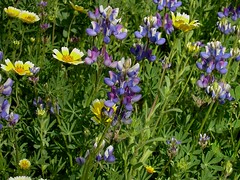
The tours give us an opportunity to take visitors around the grounds to view and interpret the wildflowers and other plant collections. The bloom is pretty good this year. The Lupines and Tidy Tips are coming in to their own. Most of the Ceanothus, Western Redbuds, and Flannelbush are spectacular.

So, if you have the time, come on over any Saturday or Sunday at 2:00 p.m. from now until May 18.